Statement in solidarity with Kashmiris from Just Peace Advocates.
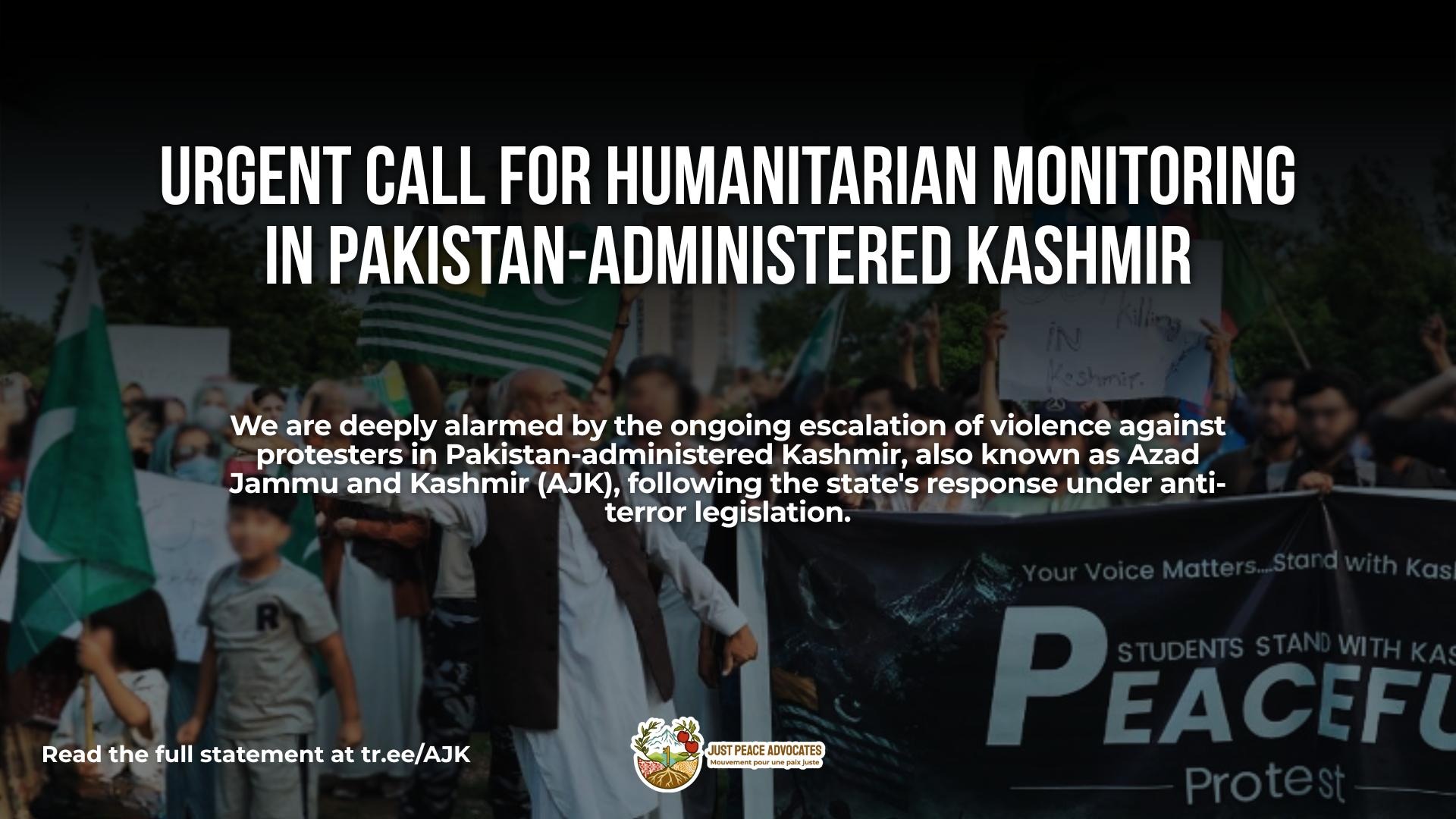
We are deeply alarmed by the ongoing escalation of violence against protesters in Pakistan-administered Kashmir, also known as Azad Jammu and Kashmir (AJK), following the state’s response under anti-terror legislation.
Amid severe restrictions on international media access, internet and telecommunications disruptions, and prolonged communication blackouts across AJK, credible reports indicate a rapidly deteriorating human rights situation. The BBC, Al Jazeera, and Amnesty International have reported that at least 40 people have been killed during the unrest, of those, 34 were protesters. Six were police and paramilitary personnel.
The Jammu Kashmir Human Rights Observatory (JKHRO) has documented a higher estimated toll, reporting 89 civilian deaths associated with the unrest. Alongside reports of excessive use of force and arbitrary arrests, communities in parts of the region have faced severe disruptions to daily life, including limited access to food, medicines, banking services, and cash withdrawals, while hospitals, educational institutions, and businesses remain closed.
The protests are being led by the Joint Awami Action Committee (JAAC), a coalition with shared leadership advocating for greater rights for Kashmiris in Pakistan-administered Kashmir. On 5 June, the Government of Pakistan proscribed the JAAC under anti-terror legislation. The movement emerged in response to longstanding socioeconomic grievances and concerns regarding political exclusion within the internationally disputed territory. In recent years, the JAAC has organized numerous demonstrations that have attracted sustained public support across the region.
The protests were initially sparked by soaring household electricity bills, rising food prices, and broader concerns over the cost of living. Among the movement’s principal demands are access to subsidized wheat and the provision of electricity generated from Kashmir’s hydropower resources to local residents at the cost of production. A highly contested issue concerns the reservation of 12 seats in the Azad Jammu and Kashmir Legislative Assembly for refugees* from Indian-occupied Kashmir residing elsewhere in Pakistan. The JAAC argues that this arrangement enables undue influence over local politics, an allegation rejected by the Government of Pakistan. These developments are unfolding in the context of regional elections, with the JAAC contending that the existing political system does not fairly represent the residents of Pakistan-administered Kashmir.
We urge the international community to:
- Facilitate the deployment of independent human rights monitors to Pakistan-administered Kashmir and ensure access for international media to verify reports of killings, excessive use of force, arbitrary arrests, enforced disappearances where alleged, and other reported human rights violations.
- Call for the immediate restoration of full internet and telecommunications services.
- Ensure the restoration of uninterrupted access to food, medicines, banking services, and other essential goods and services.
Opportunities for Kashmiris to debate, negotiate, and determine their own political futures appear to be narrowing, to the detriment of the people of the region. Whatever one’s position on the constitutional or political questions at stake, these questions should be addressed through peaceful political dialogue by Kashmiris themselves, rather than foreclosed through coercive measures.
We are also mindful that discussion of human rights concerns in Pakistan-administered Kashmir is frequently instrumentalized by the Government of India to justify its policies in Indian-occupied Kashmir. It is therefore essential to articulate these concerns without creating a false equivalence between the two contexts. Acknowledging serious human rights concerns in Pakistan-administered Kashmir should neither obscure the documented asymmetries in the scale and nature of state violence in Indian-controlled Kashmir nor prevent clear and principled engagement with developments in Pakistan-administered Kashmir on their own terms.
We appeal to the United Nations, international humanitarian organizations, and the wider international community to urge the Government of Pakistan and the authorities in Azad Jammu and Kashmir to prioritize a peaceful resolution through meaningful dialogue with the JAAC as a non-violent civic movement, while ensuring the protection of fundamental rights, humanitarian access, and the safety of all civilians.
Read the article on our website.
* Note: We are using the word refugee as referenced in regard to the seats, however, in regard to the people who are displaced as a result of ethnic cleansing from Indian Occupied Kashmir to AJK we do reference as displaced persons recognizing the Line of Control is not an international boundary.


.png)
