Fonds FTQ is the largest development capital network in Quebec and was established by the National Assembly of Quebec. They are responsible for the savings of approximately 828,000 Quebecers and over 4,600 businesses. Fonds FTQ is a particularly good divestment target because their investments are not fully indexed and exclude various companies to support Quebec entities.
“The Fonds uses the savings and solidarity of Québecers as a vector to support the economy and maintain employment” according to its mission.
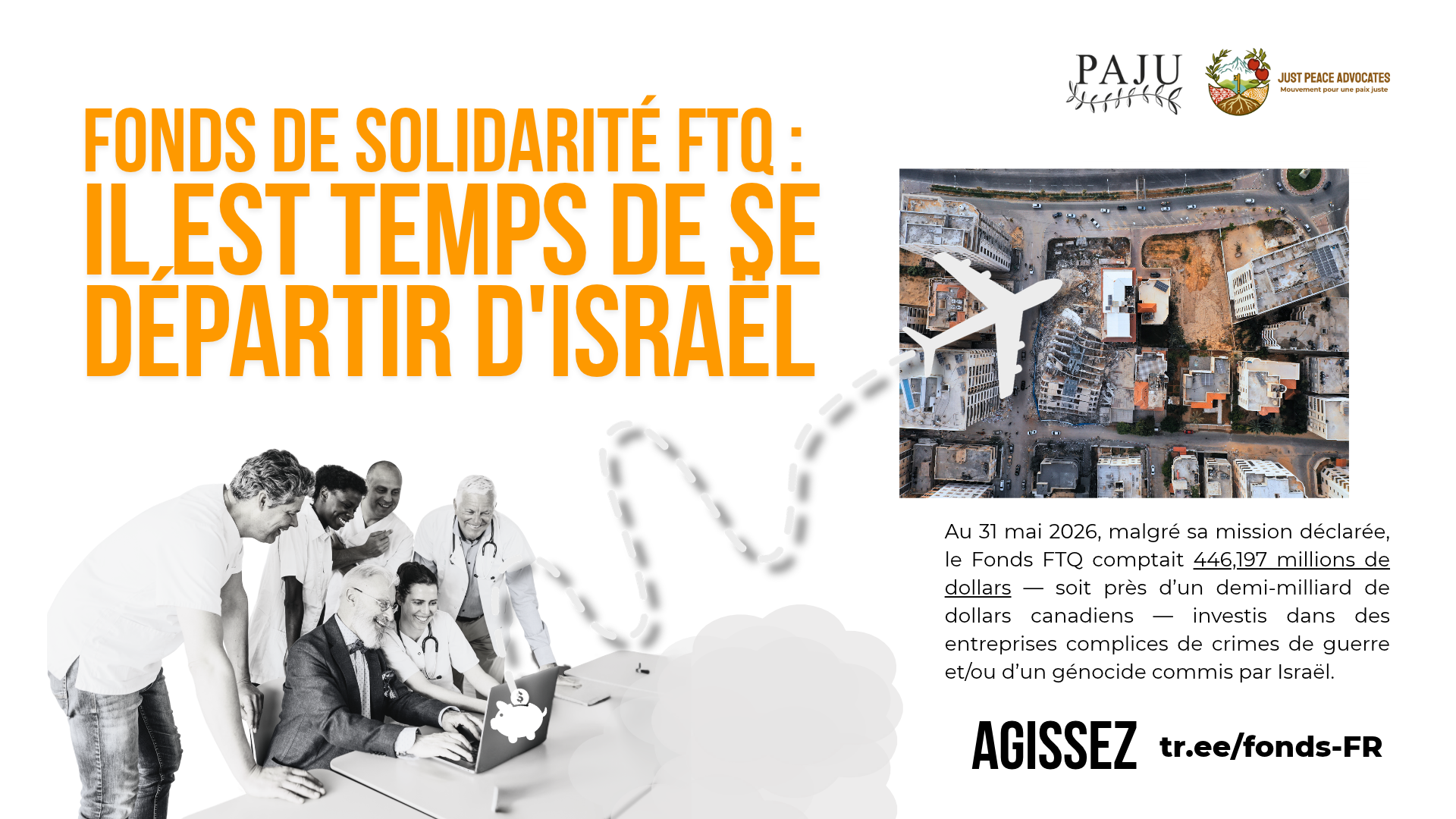
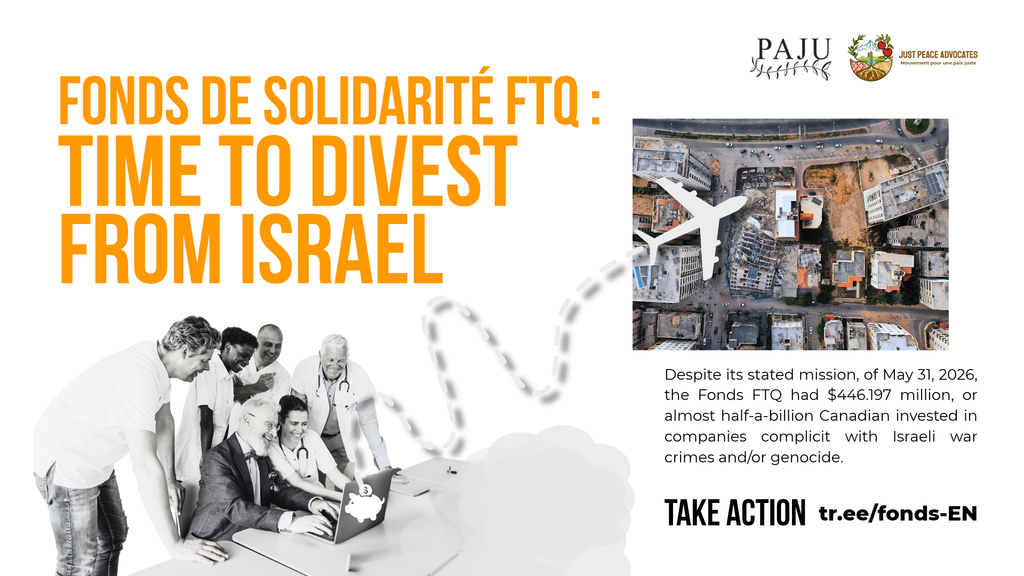
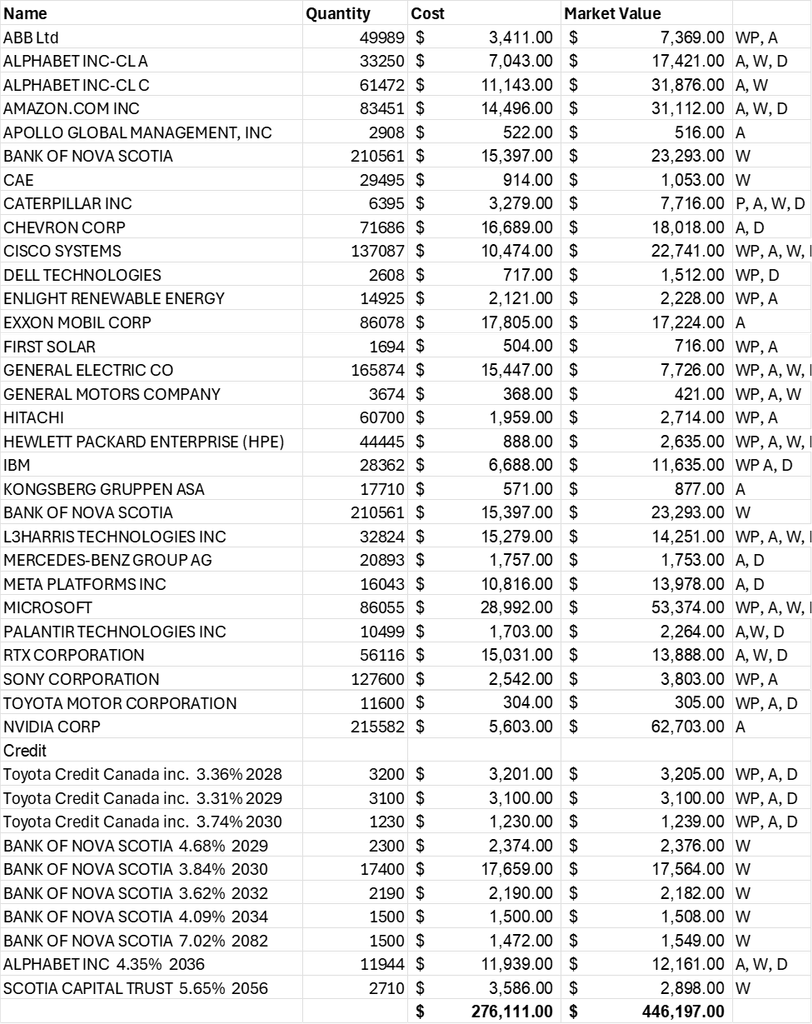
Despite its stated mission, of May 31, 2026, the Fonds FTQ had $446.197 million, or almost half-a-billion Canadian invested in companies complicit with Israeli war crimes and/or genocide.
This is not new. In 2025, Fond FTQ had over half-a-billion in complicit investments. This is the fourth year that we have reviewed Fond FTQ investments, and to date they have not responded to reach out in this regard.
However, in the May 31, 2026 reporting it seems there were no holdings in companies listed on the UN database. In May 2025, Fonds FTQ had investments in several companies on the UN list including Bank Hapolim, Booking, and Motorola Solution. Fond FTQ has not confirmed if this was a conscious decision to divest from at least the companies on the UN list. We await their response but regardless do call on them to not reinvest in companies on the UN database those in the new UN.
With investment continuing in companies that are complicit in genocide and/or war crimes like L3 Harris, Palantir, RTX, HP, General Electric, Caterpillar, Amazon and others, FTQ Fonds needs to do better for the workers, the business, the residents of Quebec.
The investments in war crimes and genocide (as of May 31, 2026 annual report)
Understanding Financial Sector complicity/Legal Analysis
The Canadian financial sector is complicit in the ongoing violations of international law by Israel in the oPt (occupied Palestinian territory) and the oSG through a variety of institutional practices and policies, as well as through their actual investments. These actions and omissions contravene international law, including those articulated in the 2024 International Court of Justice (ICJ) Advisory Opinion (2024 ICJ AO). In their October 2024 Position Paper, the UN Independent International Commission of Inquiry on the Occupied Palestinian Territory, including East Jerusalem, and Israel clearly articulated State requirements for implementing the 2024 ICJ AO.
“States must:
- abstain from entering into economic or trade dealings with Israel concerning the Occupied Palestinian Territory or parts thereof which may entrench its unlawful presence in the territory… (para 29)
- cease all financial, trade, investment, and economic relations with Israel that maintain the unlawful occupation or contribute to maintaining it… (para 29)
- examine private enterprises incorporated in the State and non-profit or non-governmental organizations registered in the State and their dealings with the State of Israel and the Occupied Palestinian Territory… (para 30)
- require a thorough due-diligence review of these entities and ensure that they are not engaging in any business, activity or financial support that maintains the unlawful occupation or contributes to maintaining it. If a State finds that such entities are engaging in activities that maintain the unlawful occupation, the State must take all reasonable measures to prevent the activities, such as revoking a corporation’s articles of incorporation or revoking a non-profit organization’s registration in that State…” (para 30)
They also explicitly describe the real risk of States failing to fulfill their international legal obligations, in particular regarding the “issue of genocide” as “all States are on notice that Israel may be or is committing internationally wrongful acts in both its conduct in the military operations in Gaza and its unlawful occupation of the West Bank, including East Jerusalem.” Therefore, “unless States cease their aid and assistance to Israel in the commission of these acts, those States shall be deemed to be complicit in those internationally wrongful acts” (para 23).
International humanitarian law (IHL) is binding on all actors where activity is closely linked to armed conflict, including business enterprises, even if they don’t take part in active hostilities. Investment managers who make investments in war-crimes-complicit companies are either wilfully blind or recklessly indifferent to the effect of their investments regarding war crimes, crimes against humanity, and ‘plausible’ genocide.
Both corporations and individuals within them can be held accountable under domestic Canadian law, as described below. International war crimes are indictable offences under the Criminal Code in Canada, based on the interplay of the Crimes Against Humanity and War Crimes Act, the Geneva Conventions Act, and the Interpretation Act. This applies not only to individuals but to all “legal persons” including “(a) a public body, body corporate, society, company, firm, partnership, trade union, or municipality, or, (b) an association of persons that is i) is created for a common purpose, ii) has an operational structure, and iii) holds itself out to the public as an association of persons.”
These violations are not limited to the oPt but include the oSG. There are countless UN resolutions affirming the existence and illegality of Israel’s occupation in the Syrian Golan and its responsibility to uphold international law including the Fourth Geneva Convention. These resolutions include but are not limited to the following: UNSC Res 237 (1967), UNSC Res 497 (1981), UNGA Res 78/77 (2023), UNGA Res 77/125 (2022), UNGA Res 76/81 (2021), UNGA Res 75/99 (2020), UNGA Res 74/90 (2019),
Investments in companies complicit in violations in the oPt and the oSG can be prosecuted domestically. For example, “aiding and abetting” war crimes is applicable in the domestic sphere. Section 21 of the Criminal Code defines “aiding and abetting” as “everyone is party to an offence who (a) actually commits it, (b) does or omits to do anything for the purpose of aiding any person to commit it or (c) abets any person in committing it.” As outlined in R v Briscoe (2010 SCC 13), the two central components to prosecute this offence are i) proof of pre-knowledge and ii) intent. Contributing to weapons supplies for the Israeli military – whether through investments or exports – materially supports violations of international humanitarian law. The 2024 ICJ AO, and longstanding Canadian policy, make it essentially impossible for entities to suggest they do not have a priori knowledge of secondary liability.
While investors often argue they are “at arms length” from a company’s actual activities, investors can and must be held accountable for their investments in complicit companies. In July 2025, UN Special Rapporteur Francesca Albanese released her report From Economy of Occupation to Economy of Genocide, indicting corporate entities for their role in furthering Israel’s occupation and genocide. She specifically condemned pension plans, banks, and insurers for their role in contributing to war crimes, genocide, apartheid, and other international law violations.
“Business continues as usual, but nothing about this system, in which businesses are integral, is neutral. The enduring ideological, political and economic engine of racial capitalism has transformed Israel’s displacement-replacement economy of occupation into an economy of genocide. This is a “joint criminal enterprise”, where the acts of one ultimately contribute to a whole economy that drives, supplies and enables this genocide… Corporate relations with Israel must cease until the occupation and apartheid end, and reparations are made. The corporate sector, including its executives, must be held to account, as a necessary step towards ending the genocide and disassembling the global system of racialized capitalism that underpins it.”
— UN Special Rapporteur Francesca Albanese
Additional Obligations
In addition to domestic law and IHL, many investment managers are accountable under the United Nations Guiding Principles (UNGPs). This is an example of a voluntary “soft law” mechanism that is “based on the notion that multinational corporations have a quasi-moral/legal responsibility for the protection of rights that have a strong nexus with the operations of the company.” The UNGPs are one of the most accepted and endorsed global standards. The framework has three core pillars: (1) States’ duty to protect against human rights abuses by third parties, including business, through appropriate policies, regulation, and adjudication; (2) the corporate responsibility to respect human rights, which means to act with due diligence to avoid infringing on the rights of others; and (3) the need for greater access by victims to effective remedies, judicial and non-judicial. UNGPs apply to the private sector and mandate human rights due diligence, including continually assessing impacts on human rights due diligence, taking steps to mitigate harm, refraining from activities that directly or indirectly support harms, and communicating transparently about how human rights impacts are evaluated and addressed.
Many institutions have also voluntarily adopted the UN Principles for Responsible Investment (PRI) principles. However, commitment to these principles ends at the mere statement of policy: the institutions do not adequately engage with due diligence process nor do they provide access to remedies.
Methodology + Inclusion Criteria
Complicit Companies
In 2025 and 2026, we have used five main sources to conduct this analysis: Who Profits, AFSC Investigate, UN Database, Canada Stop Arming Israel (as hosted by World Beyond War, WBW), and Don’t Buy Into Occupation (DBIO) (See Appendix A for a brief description of each.).1 Each of these organizations includes companies for which there is a significant amount of evidence linking them to occupation crimes. In each table below, we provide a list of sources for each company. The following legend represents the list of sources we used:
- WP: Who Profits
- A: AFSC Investigate
- W: Canada Stop Arming Israel
- U: UN Database
- D: Don’t Buy Into Occupation
In addition to providing a list of complicit investments for each entity, we have also categorized each company based on the types of activities in which it participates. This is based on evidence provided by Who Profits, AFSC Investigate, Canada Stop Arming Israel, and Don’t Buy Into Occupation. These are the seven categories we use:
- weapons manufacturing / supply and/or military support
- security services or supplies
- construction equipment, materials, or services for the demolition/destruction of occupied land/property
- services or utilities that support settlement maintenance
- exploitation of natural resources
- providing banking / financial operations or support
- surveillance / identification equipment, materials, or support
You can learn more about our process, the legal methodology and the complicity by Canadian financial institutions and pensions:
In 2023 and 2024, the analysis of FondsFTQ was based on the UN list and AFSC Investigates, so it is not possible to compare directly with the current year.
WSP
Also in 2025, Montreal based WSP “sold” its Israel office to a private company, thus WSP does not show in the 2026 year end analysis, however, Fonds FTQ continues to hold:
| WSP | Shares | Cost | Market Value |
| WSP Global inc. 2.41% 2028 | 712 | $ 712.00 | $ 701.00 |
| WSP Global inc. 4.59% 2036 | 740 | $ 740.00 | $ 735.00 |
| Total | $ 1,452.00 | $ 1,436.00 |
Despite shedding its complicit business line, WSP still needs to make reparations for its complicity in war crimes through enabling illegal occupation and settlement.
Past analysis:
2025
2024 with 2023