Immediate Release
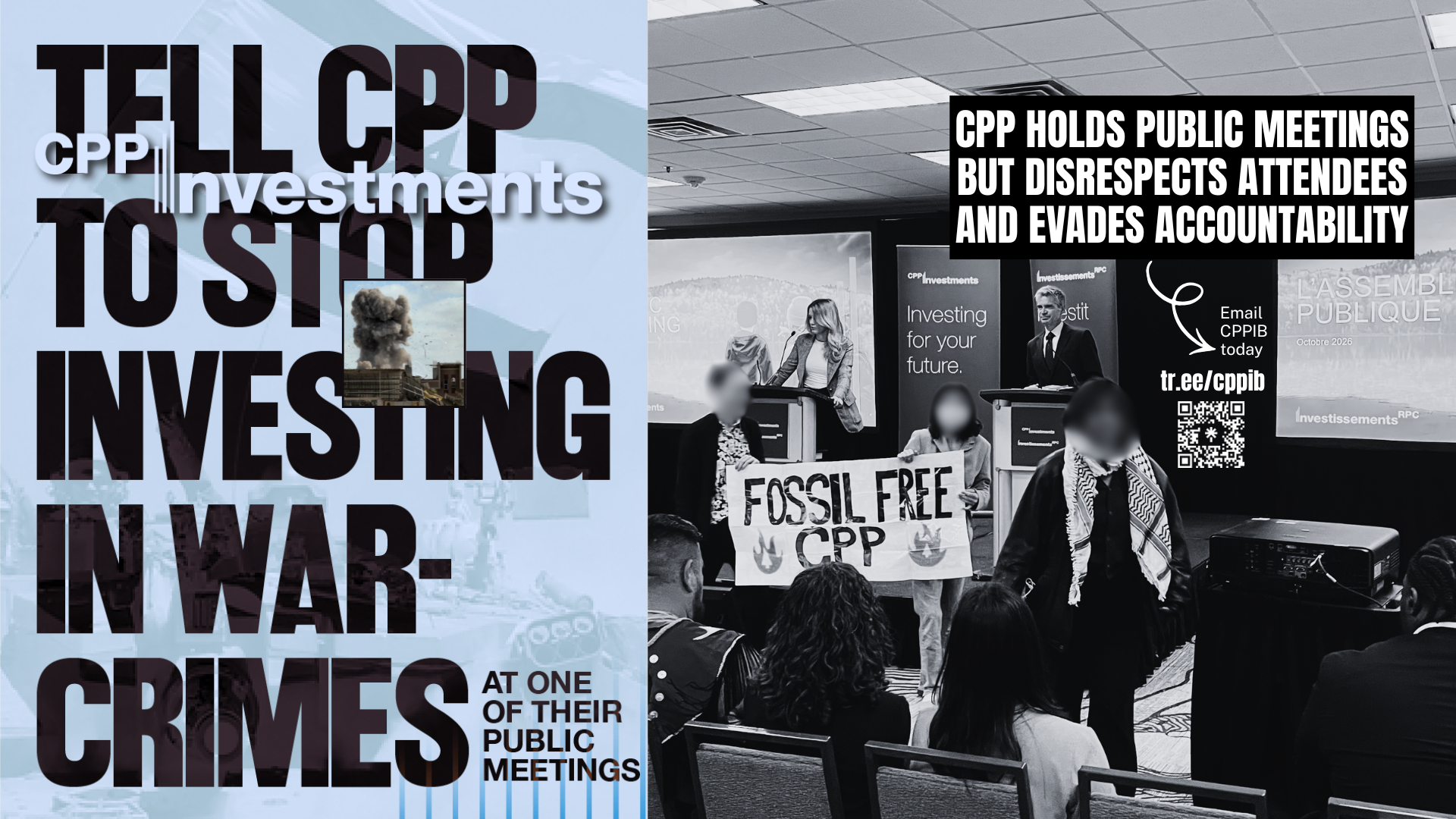
CPP holds public meetings but disrespects attendees and evades accountability
Every two years, the Canada Pension Plan Investment Board (CPPIB) is required to hold public meetings in every participating province, and allow the public to ask questions and comment. Since 2022, organizations and individuals have attended these meetings to ask the CPPIB about their complicity in Israel’s apartheid, genocide, and illegal occupation. These questions, along with concerns about fossil fuel investments and Indigenous Rights violations, have dominated the meetings. This year has been no different.
So far, CPPIB has hosted meetings in Ottawa and Vancouver. They have been met with legitimate questions and concerns, only to be dismissed with indirect and patronizing responses. In one case, CPPIB leadership walked off stage at 7:00pm while a mother holding her infant was in about to ask question.
CPPIB is required, by law, to hold these meetings. But their disdain and lack of genuine engagement with concerns is tangible. This is obvious from the following reports from Ottawa and Vancouver.
Ottawa Summary
On October 8, 2026, over 100 participants—including investors, Indigenous leaders, and civil society advocates—attended the CPPIB public meeting at the Delta Hotel in Ottawa.
Meeting Format and Disturbance
The one-hour meeting (6:00–7:00 PM) began with a presentation by Michel Leduc, Senior Managing Director and Global Head of Public Affairs and Communications. This was followed by a 30-minute Q&A session. Climate activists disrupted the event twice by walking through the venue with banners demanding fossil fuel divestment.
Q&A Restrictions and Public Backlash
Although approximately 25 people lined up at two podiums, only 8 participants were permitted to speak. At 7:00 PM sharp, despite respectful pleas from attendees to extend the session by 30 minutes to address the remaining crowd, Mr. Leduc ended the meeting abruptly and left the stage. Attendees vocally criticized the brief Q&A window as inadequate.
Key Themes Raised
Indigenous Rights: Representatives criticized CPP’s investments in companies involved in pipeline construction which have been accused of violating the Duty to Consult and Free, Prior, and Informed Consent (FPIC) under the United Nations Declaration on the Rights of Indigenous Peoples (UNDRIP). When Chief Na’Moks, a Wet’suwet’en Hereditary Chief and the highest ranking chief of the Beaver clan, asked if CPPIB would commit to establishing a formal Indigenous policy, the Board declined to commit, stating instead that they practice Indigenous “engagement.”
Fossil Fuels and Climate Change: Advocates raised health and environmental concerns regarding CPPIB’s fossil fuel and pipeline holdings, demanding divestment. The Board did not commit to divestment, pivoting instead to highlight their investments in green energy.
Human Rights and International Law:
- Engagement Policy: One attendee questioned whether the CPPIB has actually engaged, as per its sustainable investment policy, with companies on the UN list of businesses operating in illegal Israeli settlements in the occupied West Bank. The Board bypassed the direct question, speaking generally about proxy power and index-linked investments.
- Investments in Israel: Attendees also questioned the growth in CPP’s investments in Israeli companies such as banks and insurance firms, as well as other companies complicit in Israel’s illegal settlements, military occupation and genocide. Leduc claimed not to be familiar with the particulars of the investments in question, but that if there was growth in these investment areas, it was “small”.
On August 21, 2026, the Trade Commissioner Service put on an Advisory to Canadian businesses. The Government re-iterated its position that Israeli settlements are illegal. They said that “Engagement in, or connection to, settlement-related activities present significant legal, financial and reputational risks.” They advised businesses “not to participate in activities that directly or indirectly support or facilitate settlements or associated violence. This includes, but is not limited to, investments, financial transactions, procurement, purchases and tourism linked to settlement activities” [emphasis added]. Yet, Canada’s federal pension plan continues to double down.
Since 2021, Just Peace Advocates and other organizations have been demanding the CPPIB divest from Israeli war crimes. In March 2021, over 70 organizations globally and 130+ individuals including former federal members of parliament Libby Davies & Jim Manly, former UN rapporteur John Dugard, former NY Times bureau chief Chris Hedges, academics, faith community leaders, and labour leaders signed a letter urging CPPIB to divest. Jeffrey Hodgson, Director, Industry and Stakeholder Affairs at CPPIB wrote to us stating they would review the information, but no further action or response was provided. They have been reminded of this by email annually, and in-person at the 2022 and 2024, and now 2026 stakeholder meetings.
Despite this, CPPIB leadership still claims ignorance.
Vancouver Summary
On October 6, 2026, over 100 participants attended the CPPIB public meeting in Vancouver. Prior to the meeting, about 80 community members also gathered outside for a rally with signs that read “CPP stop investing in war crimes & genocide” and “My pension should fuel the future — not burn it down.”
Q&A Restrictions and Public Backlash
Approximately 20 people lined up at two podiums. At 7:00 PM sharp, CPPIB leadership hurried offstage despite several people still waiting at the mic. They left in the middle of a question from a woman holding an infant who had been patiently waiting in line.
Key Themes Raised
Indigenous Rights and Fossil Fuels: The first question was asked by Cedar George Parker from Tsleil-Waututh Nation regarding CPP’s lack of Indigenous Rights investment strategy aligned with UNDRIP. A series of questions and comments followed regarding CPPIB’s $24 billion fossil fuel assets and withdrawal of pervious net zero emissions. After several questions on the topic, Michael Leduc (CPPIB Head of Communications) said he had responded to concerns at least three times and had nothing more to add that would satisfy attendees.
Human Rights and International Law: A question was asked regarding a 2021 letter from Just Peace Advocates to CPPIB, which received a response from Jeff Hodgson (CPPIB Managing Director). At the time, he had promised in writing to review the portfolio and respond to the concerns expressed. Yet, no response was received despite follow-up. Further, in the last year CPPIB has increased investment by $23 billion in companies tied to Israel’s war crimes and just signed a $50 billion contract with Brookfield to invest in Carney’s major projects. Leduc responded that he had not heard about the $50 billion contract and did not respond to concerns regarding the letter.
This work is part of long-standing efforts to call on pension plans, including the CPPIB, to divest from companies complicit in human rights violations. For example, the Coalition Against Arms Trade produced reports calling on CPPIB’s divestment from Israeli apartheid in the early 2010’s. This work inspired Just Peace Advocates to continue this analysis beginning in 2020/21. We have also analyzed the Quebec pension plan (CDPQ) for the last four years, including most recently the 2025 Annual Report. Alongside the Coalition du Québec URGENCE Palestine, we found the CDPQ has $26.4 billion CAD invested in 81 complicit companies. Other organizations like SHIFT Action for Pension Wealth and Planet Health advocate for other changes, like comprehensive climate change strategies.
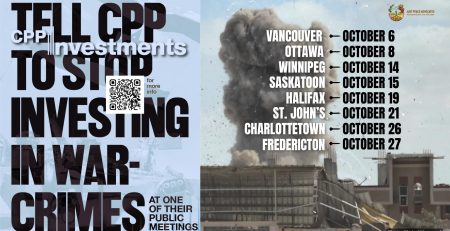
Meetings continue in Winnipeg (October 14), Saskatoon (October 15), Halifax (October 19), St. John’s (October 21), Charlottetown (October 26) and Fredericton (October 27).
For more information on CPPIB’s investments, including a legal analysis, see the report: “CPPIB Doubles Down, Increases Investments in Genocide, War Crimes, and Apartheid to More Than $54 Billion”
Quotes:
“CPPIB continues to minimize and dismiss the concerns of its investors. Attendees are not simply third-party observers, they are the funders of CPP. The disrespect CPPIB leadership shows the Canadian public is shameful. From brushing off the concerns of Indigenous leaders and communities, to cutting off individuals, to treating attendees like they are incompetent, CPPIB leadership demonstrates these public meetings are simply about fulfilling their legislated responsibility, not to any meaningful engagement. Despite that, we will continue to ensure the CPP Board has no peace until accountability. Until Indigenous Rights and Nations are respected, until our money stops being used to fund the climate crisis, until CPPIB ends its—and our—complicity in Israel’s apartheid, genocide, and illegal occupation.” — Becca Steckle, Just Peace Advocates
Media Contacts:
Just Peace Advocates, info@justpeaceadvocates.ca