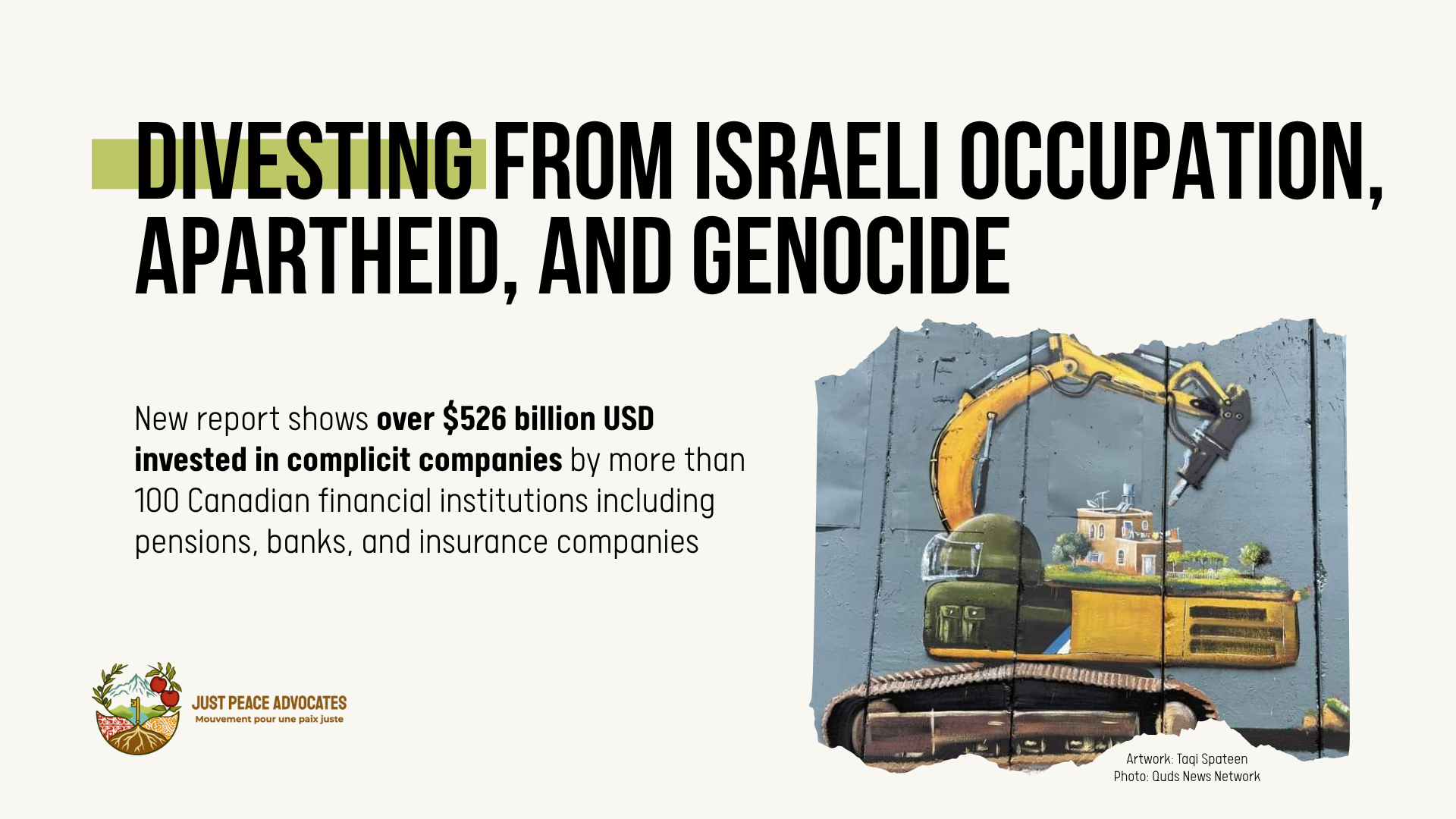
We are grateful to be releasing a brand new report analyzing the investments of more than 100 Canadian financial institutions. This analysis reveals over $526 billion USD invested in complicit companies by pensions, banks, insurance companies, and other investment managers. It is clear that the Canadian financial sector and Canadian economy are deeply invested (figuratively and literally) in Israel’s illegal military occupation, apartheid regime, and genocidal settler colonial project. It is (past) time to divest from companies supporting Israel’s crimes.
Learn about your investments, whether personal, through your bank, or pension plan. You can view the PDF version or read a text only version below. Note that because the file is large, the appendices are available in a separate file.
- Introduction
- Currently in Palestine (and Beyond)
- Legal Context
- Methodology + Inclusion Criteria
- Summary Findings
- Analysis
- Pensions
- Alberta Investment Management Corporation (AIMCo)
- British Columbia Investment Management Corporation (BCI)
- Healthcare of Ontario Pension Plan (HOOPP)
- Investment Management Corporation of Ontario (IMCO)
- Public Service Pension Investment Board (PSPIB)
- Ontario Municipal Employees Retirement System (OMERS)
- Ontario Teachers’ Pension Plan (OTPP)
- Canada Pension Plan Investment Board (CPPIB)
- La Caisse de dépôt et placement du Québec (CDPQ)
- Canada Post Corporation Pension Plan (CPCPP)
- Vestcor (Owned by the New Brunswick Public Service Pension Plan and New Brunswick Teachers Pension Plan)
- Alberta Investment Management Corporation (AIMCo)
- Banks
- Insurance Companies
- Investment Managers
- Breaking the Indexing Myth
- Pensions
- Conclusion
- Appendix A: Brief Description of Sources
Introduction
Over the last seven years, we have completed over twenty divestment reports. This has included analyses of banks, universities, pension plans, and insurance companies. This year, we have gone a step further. The following report provides the analysis of more than 100 Canadian financial institutions. This includes 11 pensions, 8 banks, 7 insurers, and 85 investment managers. Each of these financial actors play a significant role in Canada’s own settler colonial project, as well as the exploitation and colonization of lands and peoples globally. While this report focuses on the impact of Canadian investments in the occupied Palestine territory (oPt) and the occupied Syrian Golan (oSG), we recognize this is but one piece of a much larger puzzle–namely, the interconnected nature of white supremacy, imperialism, racial capitalism, and settler colonialism.
Pensions
In Canada, pensions are a major economic force. In 2021, research by the Canadian Centre for Economic Analysis found that Canada’s public-sector pension plans (CPSPPs) alone supported 877,100 jobs and 55,500 businesses across Canada, produced $33.1 billion in annual wages, and created $21.4 billion in tax revenue. At the time, CPSPPs included 3.41 million active and 1.85 million retired members. CPSPPs benefit Canada’s economy as a critical source of retirement income, representing 40% of all private retirement income nationally. CPSPPs contribute $82 billion in GDP, equivalent to 3% of the Canadian economy. Common examples of occupations of CPSPP members are teachers, municipal staff, healthcare professionals, engineers, scientists, maintenance workers, food service workers, police, and firefighters.
However, the reality is that “[p]ension funds operate as a form of extractive welfare, predicating social insurance upon exploitation of necessity.”
“…in an age of de-industrial capitalism returns on investment and ..profits ..are directly contradictory with the point of the pension itself … [which] is to enable the continued life of the worker after retirement. But the structure of that sort of capital accumulation necessitates taking value from those same sorts of necessities. There is a basic level contradiction in terms between the pension as finance and the pension as welfare. And they ultimately hit their collision point in the moment we call retirement.” — Tom Fraser
Banks
Canada is an international banking powerhouse. Dating to the 1830s, Canadian banks had become major players in the English Caribbean colonies and United States (US)-dominated Cuba by the early 1900s. Despite Canada’s small population, its five major banks are all among the largest 50 banks in the world. In this regard, it is important to consider the impact of the Canadian financial sector and the influence of its banking institutions. Canadian banks contribute about 70 billion Canadian dollars annually to the Canadian economy. The majority of Canadians are shareholders in Canadian banks either directly through share ownership or indirectly through indices and mutual funds.
Collectively, the top five Canadian banks are referred to as the “Big Five.” This is “due to their dominant position and significant influence within the country’s banking and financial industry.” These five—Royal Bank of Canada (RBC), Bank of Montreal (BMO), TD (Toronto Dominion), Bank of Nova Scotia (Scotiabank), and Canadian Imperial Bank of Commerce (CIBC) along with a sixth, the National Bank of Canada (NBC)—held about 93 percent of the banking assets in Canada in 2022. This was before the RBC purchase of HSBC, which would take this figure to about 95 percent. These six along with Desjardins are considered to be Domestic systemically important banks (D-SIB), which, should they fail, would have a significant impact on the Canadian economy.
Insurers
Canadian insurance companies play a large role in the Canadian economy. Generally speaking, there are two main categories: Property and Casualty (P&C) insurance and Life and Health (L&H) insurance. In 2022, P&C insurance contributed nearly $22 billion to Canada’s nominal gross domestic product (GDP), which correlated to a total economic impact of over $38 billion. P&C insurers also directly created 145,000 jobs, and were indirectly responsible for an overall total of 297,000 jobs in Canada. Finally, P&C insurers contributed nearly $4 billion to federal taxes in 2022, and over $8 billion to provincial taxes and levies. On the other hand, in 2024, L&H insurers paid out a record $143.3 billion in health and accident benefits. This was nearly 12% higher than 2023. They also paid out over $71 billion in retirement benefits, $18.6 billion in life insurance benefits, $10 billion in disability benefits, and $16.6 billion in prescription drug benefits. In 2024, L&H insurers held $50 billion worth of domestic infrastructure and over $1 trillion in long-term investments.
Like pensions and banks, “insurance itself has a legacy of injustice, rooted in expressions of colonialism and white supremacy that financially safeguarded the horrific practices of the trans-Atlantic slave trade, which was systemically entrenched in and protected by insurance underwriters in the United Kingdom particularly but not exclusively.” Insurance should be considered in the context of “the role of colonialism in shaping the racial capitalism and financialization from which insurance prospered and continues into the present.”
Investment Managers
A significant number of entities are listed in this report as “investment managers”. This is a broad category that includes financial firms making investments on behalf of individuals and/or institutions (e.g., pensions). However, unlike the banks, insurers, and pension plans outlined above, these investment managers report their holdings without delineating between clients. Therefore, even though some of these investment managers are investing funds on behalf of Canadian pension plans, we do not necessarily have a way of a) identifying these plans and/or b) parsing out how much of the managers’ total investments are related to any particular entity.
Currently in Palestine (and Beyond)
It is important to root this divestment work in the tangible, daily impacts on the Palestinian people. The reality that we benefit from the oppression of Palestinians—and many other peoples—is not an abstract idea. Therefore, before we dive into the analysis, let us consider the events that occur on a daily basis in Palestine and beyond. On 27 March 2026, Israel (and the US directly in the case of Iran) carried out the following crimes:
Iran
- Attacked a residential area killing 26 civilians in Isfahan, Iran
- Killed 15 civilians and injured at least 10 others in Qom, Iran
- Bombed four residential buildings, killing several individuals and injuring others in Urmia, Iran
Lebanon
- Killed several individuals, including 3-month-old infant in airstrike on Al-Saksakiya, Lebanon
- Bombed a residential building in Beirut, Lebanon
- Killed a young child, Sajid Ali Faqih, in an airstrike on Ansariyeh, Lebanon
- Killed a Lebanese woman in an airstrike on Al-Bazaliya, Lebanon
- Struck Chama, Lebanon, with a phosphorous artillery strike
- Struck Al-Bayada, Lebanon
- Bombed a vehicle in Al-Qulayleh, Lebanon
- Bombed Kafr Roummane, Lebanon
Palestine
- Raided Qalandiya Camp, occupied Jerusalem, Palestine, and killed at least one Palestinian man
- Killed a Palestinian who died after a sewage pit collapsed due to intentional Israeli destruction in the Gaza Strip, Palestine
- Raided a home and abused family members in Al-Zawiya, occupied West Bank, Palestine
- Injured a 3-year-old by gunfire in Beit Lahiya, occupied Gaza, Palestine
- Abducted a young Palestinian, Muawiya Basyouni, after storming his home in Ein Refugee Camp, occupied West Bank, Palestine
- Stormed Palestinian homes and obstructed an ambulance in Nablus, occupied West Bank, Palestine
These are just some of the events of that day. We know there are many more that have not been captured here or reported. Further, since Israel and the US restarted attacks on Iran, they have killed at least 1,500 people. Israel has also killed at least 1,116 people in Lebanon and displaced more than 1 million people since it escalated its ethnic cleansing in March 2026.
Legal Context
The Canadian financial sector is complicit in the ongoing violations of international law by Israel in the oPt and oSG through a variety of institutional practices and policies, as well as through their actual investments. These actions and omissions contravene international law, including those articulated in the 2024 International Court of Justice (ICJ) Advisory Opinion (2024 ICJ AO). In their October 2024 Position Paper, the UN Independent International Commission of Inquiry on the Occupied Palestinian Territory, including East Jerusalem, and Israel clearly articulated State requirements for implementing the 2024 ICJ AO.
“States must:
- abstain from entering into economic or trade dealings with Israel concerning the Occupied Palestinian Territory or parts thereof which may entrench its unlawful presence in the territory… (para 29)
- cease all financial, trade, investment, and economic relations with Israel that maintain the unlawful occupation or contribute to maintaining it… (para 29)
- examine private enterprises incorporated in the State and non-profit or non-governmental organizations registered in the State and their dealings with the State of Israel and the Occupied Palestinian Territory… (para 30)
- require a thorough due-diligence review of these entities and ensure that they are not engaging in any business, activity or financial support that maintains the unlawful occupation or contributes to maintaining it. If a State finds that such entities are engaging in activities that maintain the unlawful occupation, the State must take all reasonable measures to prevent the activities, such as revoking a corporation’s articles of incorporation or revoking a non-profit organization’s registration in that State…” (para 30)
They also explicitly describe the real risk of States failing to fulfill their international legal obligations, in particular regarding the “issue of genocide” as “all States are on notice that Israel may be or is committing internationally wrongful acts in both its conduct in the military operations in Gaza and its unlawful occupation of the West Bank, including East Jerusalem.” Therefore, “unless States cease their aid and assistance to Israel in the commission of these acts, those States shall be deemed to be complicit in those internationally wrongful acts” (para 23).
International humanitarian law (IHL) is binding on all actors where activity is closely linked to armed conflict, including business enterprises, even if they don’t take part in active hostilities. Investment managers who make investments in war-crimes-complicit companies are either wilfully blind or recklessly indifferent to the effect of their investments regarding war crimes, crimes against humanity, and ‘plausible’ genocide.
Both corporations and individuals within them can be held accountable under domestic Canadian law, as described below. International war crimes are indictable offences under the Criminal Code in Canada, based on the interplay of the Crimes Against Humanity and War Crimes Act, the Geneva Conventions Act, and the Interpretation Act. This applies not only to individuals but to all “legal persons” including “(a) a public body, body corporate, society, company, firm, partnership, trade union, or municipality, or, (b) an association of persons that is i) is created for a common purpose, ii) has an operational structure, and iii) holds itself out to the public as an association of persons.”
These violations are not limited to the oPt but include the oSG. There are countless UN resolutions affirming the existence and illegality of Israel’s occupation in the Syrian Golan and its responsibility to uphold international law including the Fourth Geneva Convention. These resolutions include but are not limited to the following: UNSC Res 237 (1967), UNSC Res 497 (1981), UNGA Res 78/77 (2023), UNGA Res 77/125 (2022), UNGA Res 76/81 (2021), UNGA Res 75/99 (2020), UNGA Res 74/90 (2019),
Investments in companies complicit in violations in the oPt and the oSG can be prosecuted domestically. For example, “aiding and abetting” war crimes is applicable in the domestic sphere. Section 21 of the Criminal Code defines “aiding and abetting” as “everyone is party to an offence who (a) actually commits it, (b) does or omits to do anything for the purpose of aiding any person to commit it or (c) abets any person in committing it.” As outlined in R v Briscoe (2010 SCC 13), the two central components to prosecute this offence are i) proof of pre-knowledge and ii) intent. Contributing to weapons supplies for the Israeli military – whether through investments or exports – materially supports violations of international humanitarian law. The 2024 ICJ AO, and longstanding Canadian policy, make it essentially impossible for entities to suggest they do not have a priori knowledge of secondary liability.
While investors often argue they are “at arms length” from a company’s actual activities, investors can and must be held accountable for their investments in complicit companies. In July 2025, UN Special Rapporteur Francesca Albanese released her report From Economy of Occupation to Economy of Genocide, indicting corporate entities for their role in furthering Israel’s occupation and genocide. She specifically condemned pension plans, banks, and insurers for their role in contributing to war crimes, genocide, apartheid, and other international law violations.
“Business continues as usual, but nothing about this system, in which businesses are integral, is neutral. The enduring ideological, political and economic engine of racial capitalism has transformed Israel’s displacement-replacement economy of occupation into an economy of genocide. This is a “joint criminal enterprise”, where the acts of one ultimately contribute to a whole economy that drives, supplies and enables this genocide… Corporate relations with Israel must cease until the occupation and apartheid end, and reparations are made. The corporate sector, including its executives, must be held to account, as a necessary step towards ending the genocide and disassembling the global system of racialized capitalism that underpins it.”
— UN Special Rapporteur Francesca Albanese
Additional Obligations
In addition to domestic law and IHL, many investment managers are accountable under the United Nations Guiding Principles (UNGPs). This is an example of a voluntary “soft law” mechanism that is “based on the notion that multinational corporations have a quasi-moral/legal responsibility for the protection of rights that have a strong nexus with the operations of the company.” The UNGPs are one of the most accepted and endorsed global standards. The framework has three core pillars: (1) States’ duty to protect against human rights abuses by third parties, including business, through appropriate policies, regulation, and adjudication; (2) the corporate responsibility to respect human rights, which means to act with due diligence to avoid infringing on the rights of others; and (3) the need for greater access by victims to effective remedies, judicial and non-judicial. UNGPs apply to the private sector and mandate human rights due diligence, including continually assessing impacts on human rights due diligence, taking steps to mitigate harm, refraining from activities that directly or indirectly support harms, and communicating transparently about how human rights impacts are evaluated and addressed.
Many institutions have also voluntarily adopted the UN Principles for Responsible Investment (PRI) principles. However, commitment to these principles ends at the mere statement of policy: the institutions do not adequately engage with due diligence process nor do they provide access to remedies.
Methodology + Inclusion Criteria
Complicit Companies
We have used five main sources to conduct this analysis: Who Profits, AFSC Investigate, UN Database, Canada Stop Arming Israel (as hosted by World Beyond War, WBW), and Don’t Buy Into Occupation (DBIO) (See Appendix A for a brief description of each.).1 Each of these organizations includes companies for which there is a significant amount of evidence linking them to occupation crimes. In each table below, we provide a list of sources for each company. The following legend represents the list of sources we used:
- WP: Who Profits
- A: AFSC Investigate
- W: Canada Stop Arming Israel
- U: UN Database
- D: Don’t Buy Into Occupation
In addition to providing a list of complicit investments for each entity, we have also categorized each company based on the types of activities in which it participates. This is based on evidence provided by Who Profits, AFSC Investigate, Canada Stop Arming Israel, and Don’t Buy Into Occupation. These are the seven categories we use:
- weapons manufacturing / supply and/or military support
- security services or supplies
- construction equipment, materials, or services for the demolition/destruction of occupied land/property
- services or utilities that support settlement maintenance
- exploitation of natural resources
- providing banking / financial operations or support
- surveillance / identification equipment, materials, or support
To demonstrate the role of these companies and their impact, you will see throughout the analysis that we highlight one complicit company per entity.
Financial Institutions
Most financial institutions are not required by law to disclose their investments publicly. There are exceptions, such as the Canada Pension Plan (CPP) and La Caisse de dépôt et placement du Québec (CDPQ or La Caisse). Other entities willingly disclose, often in response to advocacy campaigns such as those by university students fighting against climate change and for Indigenous rights. However, the majority of financial institutions reject disclosure. That being said, some institutions are required by US law to disclose certain investments to the US Securities and Exchange Commission (SEC). This data is the basis for the analysis in this report.
The financial institutions we included were identified by searching the SEC website for any companies with a) headquarters in Canada, b) who had filed a 13F-HR form in 2025, c) and who reported over $10 million to the SEC in the previous quarter. The 13F-HR is part of the inclusion criteria because it is the form used by companies who are required to submit a detailed list of holdings to the SEC. Finally, each company’s filings were assessed to confirm if they submitted additional holdings under any other investment managers (which is listed on their 13F-HR submission).
SEC Data Analysis
As stated above, only certain entities are required to file their investments with the US SEC. Therefore, it is crucial to note that this analysis only includes a) Canadian financial entities that are legally required to disclose investments to the US SEC and b) complicit companies that are registered / issued under certain US legislation.
The SEC filings we use in this report represent only a fraction of the investments made by each of the financial institutions. For example, investments in companies that are only listed on the Toronto Stock Exchange, like the Canadian company Héroux-Devtek, will not appear on quarterly SEC filings. This also means Israeli companies not listed / registered under US security laws, such as Israeli banks, will not be included in this analysis. Therefore, the figures represented in this report are likely largely underestimated. For example, HOOPP has approximately $132 billion in net assets,; however, only about $60 billion is reported to the SEC. Therefore, we are unable to analyze the remaining $72 billion of HOOPPs assets. For this reason, this report also cannot be compared to our previous reports on the CPP or CDPQ. The former analyses were based on full portfolios, disclosed as part of their legal obligations. We will continue separate analyses on these complete portfolios when they are released.
Further, as with any investment portfolios, the data represents a point-in-time snapshot taken at the ends of each fiscal quarter (March, June, September, December).2 Therefore, while we may share what appear to be definitive statements (e.g., the pension has not reinvested in the this company since Q1), it is technically possible that the company has bought shares in-between reporting periods. However, what is useful is looking at quarter over quarter results to assess which holdings are consistent and which appear sporadically.
Finally, the figures in this report may differ slightly from previous reports. For example, Q1 complicit investments from pension plans may not match those listed in the “Our Pensions Are Funding Genocide” 2025 report. This is because our database is regularly updated to reflect changes in the original sources (e.g., Who Profits, AFSC Investigate). This means companies may be added or removed based on new evidence, therefore changing the result of the analyses. Similarly, Q1 complicit investments from banks may not match those listed in the “Banking on Genocide” 2025 report. In addition to the reasons above, this is also because some banks report their holdings through several investment managers. This means that to obtain an overall picture, we compile the results from multiple SEC filings. Since our previous report, we have identified at least one additional investment manager.
Summary Findings
Pensions
In total, we identified over $78 billion USD of complicit investments from Canadian public-sector pension plans.
| AIMCo | Alberta Investment Management Corporation | $608,782,009 |
| BCI | British Columbia Investment Management Corporation | $4,345,607,001 |
| HOOPP | Healthcare of Ontario Pension Plan | $8,830,502,291 |
| IMCO | Investment Management Corporation of Ontario | $2,141,981,469 |
| PSPIB | Public Service Pension Investment Board | $7,988,507,878 |
| OMERS | Ontario Municipal Employees Retirement System | $3,425,202,996 |
| OTPP | Ontario Teachers’ Pension Plan | $291,742,046 |
| CPPIB | Canada Pension Plan Investment Board | $36,350,609,125 |
| CDPQ | La Caisse de dépôt et placement du Québec | $13,545,029,147 |
| CPCPP | Canada Post Corporation Pension Plan | $826,073,963 |
| Vestcor | (Owned by the New Brunswick Public Service Pension and New Brunswick Teachers Pension) | $623,949 |
| Total | $78,354,661,874 |
Banks
In total, we identified over $294 billion USD of complicit investments from Canadian banking institutions.
| BMO | Bank of Montreal | $57,879,902,388 |
| RBC | Royal Bank of Canada | $108,306,650,000 |
| CIBC | Canadian Imperial Bank of Commerce | $21,171,126,201 |
| BNS | Bank of Nova Scotia or Scotiabank | $34,319,213,156 |
| TD Bank | Toronto Dominion Bank | $42,915,091,676 |
| Desjardins | Fédération des caisses Desjardins du Québec | $3,515,300,321 |
| Vancity | Vancity Credit Union | $219,923 |
| NBC | National Bank of Canada | $26,530,775,384 |
| Total | $294,638,279,049 |
Insurers
In total, we identified over $91 billion USD of complicit investments from Canadian insurance companies.
| Manulife | $23,928,177,582 |
| Canada Life | $16,158,564 |
| Allstate | $1,508,805,460 |
| Empire Life | $493,432,013 |
| Intact | $237,303,336 |
| Sun Life | $65,561,788,127 |
| Fairfax | $30,577,233 |
| Total | $91,776,242,315 |
Overall Findings
In total, we identified nearly $526 billion USD of complicit investments from Canadian institutions.
Managers $61.2B
Pensions $78.4B
Insurers $91.8B
Banks $294.6B
Analysis
Pensions
The pension plans included in this report are the following:
- AIMCo (Alberta Investment Management Corporation)
- BCI (British Columbia Investment Management Corporation)
- HOOPP (Healthcare of Ontario Pension Plan)
- IMCO (Investment Management Corporation of Ontario)
- PSPIB (Public Service Pension Investment Board)
- OMERS (Ontario Municipal Employees Retirement System)
- OTPP (Ontario Teachers’ Pension Plan)
- CPPIB (Canada Pension Plan Investment Board)
- CDPQ (La Caisse de dépôt et placement du Québec)
- CPCPP (Canada Post Corporation Pension Plan)
- Vestcor (Owned by the New Brunswick Public Service Pension Plan and New Brunswick Teachers Pension Plan)
Together, these pension plans hold over $91 billion USD of investments in companies actively participating and/or complicit in violations of international law in the oPt / oSG ($91,899,691,021 USD). As detailed through the remainder of the report, each of the pension plans has complicit investments, with the majority of complicit investments in companies that support surveillance, weapons, and/or settlement maintenance.
Alberta Investment Management Corporation (AIMCo)
AIMCo is responsible for the investments of nine pension plans, along with endowment, government, insurance, and specialty funds. The nine pensions include Alberta Teachers’ Retirement Fund, Local Authorities Pension Plan, Management Employees Pension Plan, Management Supplementary Retirement, Provincial Judges & Applications Judges Registered Pension Plan, Provincial Judges & Application Judges Unregistered Pensions Plan, Public Service Pension Plan, Special Forces Pension Plan, and Universities Academic Pension Plan.
Total Q4 investments reported to SEC: $16,910,896,883
Total Q4 investments in complicit companies: $608,782,009
- 3.6% of total Q4 holdings reported to SEC are in complicit companies
Overall, AIMCo decreased its total complicit holdings between Q1 and Q4, going from 5.8% to 3.6%. In 2025, AIMCo held shares in four companies on the UN database: Airbnb, Booking Holdings, Expedia, and Motorola Solutions. As of Q4, they remain invested in all but Airbnb, for a total of more than $13 million.
The decrease in military, settlement, and surveillance activities between Q1 and Q2 represents a significant decrease in investments in major technology companies including Alphabet, Amazon, Microsoft, and NVIDIA. The increase in military activities between Q3 and Q4 reflects significant gains in General Motors, Howmet Aerospace, and NVIDIA.
The increase in settlement activities between Q3 and Q4 is not only a reflection of additional shares in Alphabet and Amazon but also new holdings in Expedia and Wyndham Hotels & Resorts. AIMCo did not have shares in the latter two companies from Q1 to Q3.
Exxon Mobil Corporation
Location: occupied Palestinian territory
Exxon Mobil is the largest international, publicly-traded oil and gas company in the world. Exxon began providing Israel with fuel in 2003, specifically for its military programs. Their fuel is designed for the F-15 and F-16 fighter jets, Merkava tanks, and Apache helicopters. They’ve also provided diesel fuel for other Israeli military vehicles like jeeps and heavy trucks. It is only because of fuel that Israeli military jets and vehicles continue to operate.
Also implicated in Indonesia
British Columbia Investment Management Corporation (BCI)
BCI acts as the investment manger for 10 public pensions, 3 insurance funds, and 19 special purpose funds. The 10 pensions include BC Hydro and Power Authority Pension Plan, British Railway Company, College Pension Plan, Insurance Corporation of British Columbia, Municipal Pension Plan, Public Service Pension Plan, Teachers’ Pension Plan, University of Victoria Combination & Money Purchase Pension Plan, University of Victoria Staff Pension Plan, and WorkSafeBC Pension Plan.
Total Q4 investments reported to SEC: $18,956,891,516
Total Q4 investments in complicit companies: $4,345,607,001
- 22.9% of total Q4 holdings reported to SEC are in complicit companies
Overall, BCI slightly increased its total complicit holdings between Q1 and Q4, going from 21.1% to 22.9%. In 2025, BCI held shares in four companies on the UN database: Airbnb, Booking Holdings, Expedia, and Motorola Solutions. As of Q4, they remain invested in all for a total of over $58 million.
BCI increased all but two of their complicit investments between Q3 and Q4. The only two they sold shares in were BRP and CAE, two Canadian companies whose products are used by the Israeli military. That being said, they still hold shares in each, worth $1.4 and $5.1 million respectively.
CAE
Location: occupied Palestinian territory
CAE is a Canadian manufacturer of “simulation and modelling technologies and training services for civil aviation and defence.” They partnered with various Israeli arms companies including IAI, Aeronautics Defense Systems, and Elbit. They also supplied trainers and aircraft simulators to the Israeli military. CAE boasts itself as a high-tech company that uses Artificial Intelligence and Machine Learning algorithms to improve the training experience. An Israeli Lieutenant Colonel was quoted saying that “simulator-based training not only hones skills but also saves the military hundreds of millions of dollars. ‘You can’t train at any moment and in any situation, but in the simulator, it’s possible’…Pilots can practice high-risk scenarios that would be too dangerous or impractical in live training. AI-driven simulations introduce unpredictable elements, forcing pilots to adapt in real time.” In July 2025, the Arms Embargo Now campaign exposed 6 shipments CAE had made to Elbit Systems throughout 2024 and 2025.
Healthcare of Ontario Pension Plan (HOOPP)
HOOPP is responsible for the pension plans of more than 500,000 individuals and nearly 900 employers. It includes every Ontario hospital and over 95% of primary healthcare workers.
Total Q4 investments reported to SEC: $59,787,234,734
Total Q4 investments in complicit companies: $8,830,502,291
- 14.8% of total Q4 holdings reported to SEC are in complicit companies.
Overall, HOOPP decreased its total complicit holdings between Q1 and Q4, going from 16.1% to 14.8%. However, it was even lower in Q3 at 13.9%. In 2025, HOOPP held shares in four companies on the UN database: Airbnb, Booking Holdings, Expedia, and Motorola Solutions. As of Q4, they remain invested in all four for a total of over $100 million.
Like most, if not all, investors, HOOPP holds significant shares in Alphabet (Google). However, it is notable that between Q1 and Q4, they increased their shares by over 3 million, with their shares currently worth $1.4 billion.
HOOPP did sell all their shares in several companies over the course of 2025. Of particular note, HOOPP sold all their shares in several weapons companies such as Lockheed Martin, General Dynamics, Palantir, Northrop Grumman, and Textron, and has not, to our knowledge, reinvested since.
Minerals Technologies Inc
Location: occupied West Bank
Minerals Technologies is a US company that provides specialty products for various industries. One of its subsidiaries, CETCO, participated in the construction of the Bardala bypass pipeline. This was a project by Mekorot, Israel’s national water company, in the occupied West Bank. Mekorot is listed on the UN Database of companies operating illegally in Israeli settlements. The bypass pipeline exports underground water from the Palestinian village Bardala to illegal settlements for drinking and agricultural purposes. Palestinians are not able to access their own water sources because of this project.
Al-Haq has extensively documented the reality of Israel’s “water apartheid” describing “how, through the curtailment and policing of water access, the destruction of Palestinian water infrastructure, and the pillaging of Palestinian water sources, Israel uses businesses to appropriate Palestinian water sources and sell this pillaged water back to Palestinians at ever increasing prices, as a captive market.” Al-Haq explicitly names Merkorot, along with several other corporations, as complicit in war crimes and human rights violations.
The impact on Palestinian individuals and farmers is immense. Often, as was the case in Bardala in 2018, the Israeli military will ‘militarize an area’ to search for ‘illegal’ water holes used by farmers. Palestinian farmers and communities are deprived of accessing land and subsequently find their water structures confiscated. This has detrimental economic effects, as many of these communities depend on agriculture. The result: Palestinians are left with “no choice but to work on the lands of illegal Israeli settlements – lands that were expropriated from Palestinian families.” While Palestinian farmers are forced to “abandon their agricultural activities due to the confiscation of their water pumps,” Israeli settlements receive unlimited water. In one instance documented by Al-Haq, a water catchment basement used for agricultural purposes was demolished by the Israeli military. Mekorot, in particular, has created a monopoly through its imposition of a “water apartheid” to not only boost their boost commercial profit but make the OPT dependent on them.
The employment of Palestinians in settlement businesses does not, in any case, remedy settlement businesses’ contribution to violations of international human rights and humanitarian law. The cumulative impact of Israeli discrimination, as documented in this report and numerous others, is to entrench a system that contributes to the impoverishment of many Palestinian residents of the West Bank while directly benefitting settlement businesses, making Palestinians’ desperate need for jobs a poor basis to justify continued complicity in that discrimination. – Al-Haq
Investment Management Corporation of Ontario (IMCO)
IMCO manages assets for various government agencies, crown corporations, and pension funds. This includes the Ontario Pension Board (administration of the Public Service Pension Plan), WISE Trust (administrator of the WSIB Employees’ Pension Plan), Provincial Judges’ Pension Board (administrator of the Provincial Judges’ Pension Plan), and City of Ottawa’s OC Transpo Employees Pension Plan.
Total Q4 investments reported to SEC: $7,510,912,927
Total Q4 investments in complicit companies: $2,141,981,469
- 28.5% of total Q4 holdings reported to SEC are in complicit companies.
Overall, IMCO increased its total complicit holdings between Q1 and Q4, going from 23% to 28.5%. In 2025, AIMCo held shares in four companies on the UN database: Airbnb, Booking Holdings, Expedia, and Motorola Solutions. As of Q4, they remain invested in all for a total of over $63 million.
Between Q1 and Q4, IMCO’s percentage of complicit investments increased from 23% to 28.5%, despite only adding one new holding (BRP Inc) in 2025. The increase therefore, is the result of purchasing additional shares of companies already in their portfolio. The biggest increases were of shares in NVIDIA, Ford Motor Company, Intel Corp, Exxon Mobil, and Cisco. All of these companies are involved in activities related to the military. Therefore, it is no surprise that we see a steady increase in military activity holdings from Q1 to Q4.
General Electric
Location: occupied Syrian Golan and occupied Palestinian Territory
General Electric is a multinational company that is active in various industries including power, renewable energy, aviation, and healthcare. They provide equipment and maintenance services to two major wind energy projects in the oSG–Emek Habach and Ruach Beresheet. The first is a wind farm built by Enlight Renewable Energy in partnership with 6 illegal settlements (Kidmat Zvi, Elrom, Alonei HaBashan, Odem, Neve Ativ, and Ortal). The project, which began in March 2022, includes 34 General Electric wind turbines. The company also employs electrical engineers and field technicians for maintenance, management and training, purchase orders, equipment ordering, and inventory management. The second project was also developed by Enlight in partnership with 8 illegal settlements (Yonatan, Alonei HaBashan, Ramat Magshimim, Mevo Hama, Natur, Kanaf, Avnei Eitan, and Ma’ale Gamla). General Electric provided 39 wind turbines and manages the production, supply, transportation, housing, and running of the turbines on site. They are also contracted to provide maintenance and operation services for 20 years. Along with the turbines themselves, the project also includes the construction of roads and a high-speed internet line for the illegal settlements.
Al Marsad has been advocating alongside activists in the oSG against these wind farms for years. Along with some of these wind farms expropriating more land, they also “permanently alter the environment” and the “energy produced will supply the Israeli electric grid, with minimal benefits to the local population.” Since the fall of the Assad regime in Syria in December 2024, the Israeli military increased its activities in the oSG. Israel quickly facilitated the transfer of 29,000 settlers into 35 illegal settlements that profit from the Syrian Golan’s natural resources. General Electric and other companies that build and maintain wind farms are complicit in these activities.
Further, General Electric provides engines and other components for F-16 and F-15 fighter jets as well as Apache helicopters, both used by Israel in attacks on Gaza and the West Bank. Their gas turbines are also used in the Israeli Navy’s attack ships to “enforce the illegal naval blockade of Gaza.”
Public Service Pension Investment Board (PSPIB)
PSPIB manages the pensions funds for members of the public-sector pension plans of federal public service employees, the Canadian Forces, and the Royal Canadian Mounted Police (RCMP). Their portfolio consists of approximately $300 billion.
Total Q4 investments reported to SEC: $29,783,433,830
Total Q4 investments in complicit companies: $7,988,507,878
- 26.8% of total Q4 holdings reported to SEC are in complicit companies.,
Overall, PSPIB increased its total complicit holdings between Q1 and Q4, going from 23.1% to 26.8%. In 2025, PSPIB held shares in five companies on the UN database: Airbnb, Booking Holdings, Expedia, Tripadvisor, and Motorola Solutions. As of Q4, they remain invested in all five, for a total of nearly $400 million.
PSPIB increase from Q2 to Q4 in companies involved in military activity is largely due to additional shares in NVIDIA, Total Energies, Alphabet, and Amazon. They also bought additional shares in Motorola Solutions between Q2 and Q4, for a total value of $143 million as of December 31, 2025. Notably, PSPIB owns shares in four Israeli companies: Teva Pharmaceuticals, Solaredge, ICL Group, and Elbit Systems.
ICL Group Ltd
Location: occupied West Bank, occupied Syrian Golan
An Israeli company, the ICL Group produces specialized minerals and chemicals for various industries. The minerals it uses are extracted from the Dead Sea. For example, its wholly owned subsidiary, Dead Sea Works Ltd., “holds a concession to utilize the natural resources of the Dead Sea until March 31, 2030. The concession covers an area of 652 square meters, and allows the company to construct and expand pumping stations, roads, wells, drillings, and other facilities in the Dead Sea.” Dead Sea Works extracts potash, salt, and bromide from the Northern Basin of the Dead Sea, located in the occupied West Bank. Another of ICL Group’s fully owned subsidiaries, Fertilizers and Chemicals (ICL Haifa), was documented in multiple illegal settlements in the occupied West Bank and oSG, including Naama, Mehola, and Na’aran.
Ontario Municipal Employees Retirement System (OMERS)
OMERS provides the pension plan for employees of Ontario municipalities, local boards, public utilities, and non-teaching school board staff. They have approximately 665,000 active and retired members and over $145 billion in net assets.
Total Q4 investments reported to SEC: $14,030,814,653
Total Q4 investments in complicit companies: $3,425,202,996
- 24.4% of total Q4 holdings reported to SEC are in complicit companies.
Overall, OMERS increased its total complicit holdings between Q1 and Q4, going from 21.6% to 24.4%. In 2025, OMERS held shares in four companies on the UN database: Airbnb, Booking Holdings, Expedia, and Motorola Solutions. As of Q4, they remain invested in all four, for a total of nearly $24 million.
OMERS added a few new companies to their portfolio in Q4. This included Total Energies, Logitech, Children’s Place, and CAE. Three of these companies (Total Energies, Logitech, and CAE) are engaged in military-related activities, while Children’s Place is involved in settlement activity.
Notably, OMERS did have an investment in Elbit Systems in both Q2 and Q3. In total, in 2025, they held shares in five Israeli companies including Elbit, Cellebrite, Teva Pharmaceuticals, ZIM, and ICL Group.
Cellebrite DI Ltd
Location: occupied Palestinian territory
Cellebrite is an Israeli digital intelligence company that provides technologies to the Israeli police and intelligence agencies. Since October 7, 2023, Israel has “used Cellebrite tools to harvest data from the phones of thousands of Palestinians who were captured and kidnapped from Gaza.” The Israeli police have used Cellebrite technology since at least 2016.
Also implicated in US Customs and Border Protection (CBP) and Immigration and Customs Enforcement (ICE) activities, US prison agencies and police departments, surveillance on asylum seekers and activists
Ontario Teachers’ Pension Plan (OTPP)
OTPP provides the pension plan for teachers across Ontario, with net assets of more than $250 billion.
Total Q4 investments reported to SEC: $4,522,095,979
Total Q4 investments in complicit companies: $291,742,046
- 6.5% of total Q4 holdings reported to SEC are in complicit companies.
Overall, OTPP decreased its total complicit holdings between Q1 and Q4, going from 15.6% to 6.5%. In 2025, OTPP held shares in three companies on the UN database: Airbnb, Booking Holdings, and Expedia. As of Q4, they remain invested in all three, for a total of approximately $6.4 million.
Unlike every other pension plan analyzed here, OTPP actually decreased their investments in military and surveillance activities. In 2025, OTPP held investments in four companies involved in surveillance (Cisco Systems, Leidos, Microsoft, and Polaris). However, as of December 31, 2025, they held only investments only in Polaris. That being said, while the total value of investments in companies engaged in military activity decreased over 300%, the percent of OTPP’s investments in military activity actually increased from Q1 to Q4 (83% to 87%).
Polaris Inc
Location: occupied West Bank
Polaris supplies the Israeli military with all-terrain vehicles (ATVs). It has done so since 2006. The Israeli Settlement Ministry also distributed Polaris vehicles to 59 illegal settlements in the occupied West Bank in 2025. These were provided to “remote ‘settler farms’ and ‘shepherding outposts’…The vehicle purchase was part of a $20 million package that also included drones, night vision goggles, and other “security” measures.”
Also implicated in: US police and ICE activities
Canada Pension Plan Investment Board (CPPIB)
CPP is the Canadian national social insurance plan (with the exception of Quebec which has CDPQ). CPP is funded through contributions from employees, employers, and self-employed individuals – aka, the residents of Canada. CPP “provides income replacement to contributors and their families in the event of retirement, disability or death.” CPP funds are managed by the CPP Investment Board (CPPIB) which focuses on “maximizing long-term returns without undue risk of loss.” In other words, CPPIB decides how to invest the contributions of millions of individuals in Canada.
Total Q4 investments reported to SEC: $149,516,294,752
Total Q4 investments in complicit companies: $36,350,609,125
- 24.3% of total Q4 holdings reported to SEC are in complicit companies.
Overall, CPPIB increased its total complicit holdings between Q1 and Q4, going from 19% to 24.3%. In 2025, CPPIB held shares in five companies on the UN database: Airbnb, Booking Holdings, Tripadvisor, Motorola Solutions, and Expedia. As of Q4, they remain invested in all five, for a total of more than $376 million.
Like other pensions listed here, CPPIB has investments in several Israeli companies. These include Cellebrite, Enlight Renewable Energy, ICL Group, Teva Pharmaceuticals, and ZIM. Interestingly, at no point in 2025 did they decrease their shares in any of these companies; CPPIB only held the same number of shares or bought more. In Q1, they held approximately $21 million in Israeli companies, but by the end of 2025, the value was over $90 million.
Enlight Renewable Energy
Location: occupied West Bank and occupied Syrian Golan
Enlight builds and operates solar and wind power plants. It is based in Israel and operates two wind farms in the oSG. In 2014, the Israeli Ministry of National Infrastructures, Energy, and Water Resources granted a conditional license to Enlight “for the production [of] 400 megawatts of electricity from wind-driven turbines in the Occupied Syrian Golan.” For more information, read about General Electric’s involvement in these wind farms.
Further, one of Enlight’s subsidiaries, Enlight-Kidmat Zvi LP, runs a solar project in the illegal settlement of Kidmat Tzvi in the oSG. Another subsidiary, Peirot HaGolan-Enlight LP, runs a solar field in the illegal settlement of Merom Golan. Enlight also installed six PV systems in partnership with Mei Golan Water corporation. In both the oSG and occupied West Bank, Enlight participated in a pilot project with the Ministry of Energy and the Ministry of Agriculture & Rural Development “to examine the feasibility of the dual use of agricultural land for electricity generation from solar energy.”
Enlight directly extracts and facilitates the exploitation of natural resources from indigenous Syrian and Palestinian land. Meanwhile, the Israeli occupation targets Palestinian and Syrian agricultural land. For instance, Israeli forces cut down trees, sprayed chemical pesticides, bulldozed agricultural land, and prevented farmers from accessing their land in the oSG.
La Caisse de dépôt et placement du Québec (CDPQ)
La Caisse de dépôt et placement du Québec (CDPQ) represents itself as a “global investment group” with a total of $473.3 billion assets worldwide. CDPQ was created in 1965 through an Act passed by the National Assembly of Québec, to manage funds for the newly-established Québec Pension Plan (QPP). By 2004, CDPQ’s net assets had surpassed $100 billion. Notably, in 2006, CDPQ signed onto the UN’s Principles for Responsible Investment.
Total Q4 investments reported to SEC: $58,951,531,674
Total Q4 investments in complicit companies: $13,545,029,147
- 23% of total Q4 holdings reported to SEC are in complicit companies.
Overall, CDPQ increased its total complicit holdings between Q1 and Q4, going from 20% to 23%. In 2025, CDPQ held shares in four companies on the UN database: Airbnb, Booking Holdings, Motorola Solutions, and Expedia. As of Q4, they remain invested in all five, for a total of more than $740 million.
Despite following through on no investments in Israeli companies, its investments in companies complicit increased from $9.5 billion in Q1 to $13.5 billion in Q4.
L3Harris
Location: occupied Gaza
L3Harris is a US weapons manufacturer and the 12th largest weapons manufacturer globally. “L3Harris components are integrated into multiple weapon systems used by the Israeli military, including Israel’s air-to-ground bombs as well as its main warplanes, battle tanks, and warships.” One of their key products is a component for the Joint Direct Attack Munitions (JDAM) that converts “unguided air-to-ground bombs into precision ‘smart’ bombs.” JDAM-guided bombs have been used by the Israeli military in Gaza as early as 2012. In 2021, JDAM-guided bombs were directly linked to the murder of at least 44 civilians in Gaza. L3Harris also states it is one of the top five suppliers for the F-35 jets, one of Israel’s primary military planes. Further, L3Harris manufactured the management systems for two types of Israel’s warships, which are the main units of the Israeli Navy. Prior to selling its security business to Leidos, L3Harris supplied screening technologies for the Israeli military to use at illegal military checkpoints in occupied Palestine.
Also implicated in Lebanon, US CBP and ICE activities
Canada Post Corporation Pension Plan (CPCPP)
The Canada Post Corporation Pension Plan has nearly 100,000 members and has over $27 billion in assets. Canada Post employees are eligible for the pension after two years of continuous service.
Total Q4 investments reported to SEC: $2,625,451,451
Total Q4 investments in complicit companies: $826,073,963
- 31.5% of total Q4 holdings reported to SEC are in complicit companies.
Overall, CPCPP increased its total complicit holdings between Q1 and Q4, going from 12.5% to 31.5%. In 2025, CPCPP held shares in four companies on the UN database: Airbnb, Booking Holdings, Motorola Solutions, and Expedia. As of Q4, they remain invested in all four, for a total of nearly $21 million.
CPCPP only began reporting their holdings to the SEC in Q1 of 2025. The value of their investments in Q1 was significantly lower than later quarters. That being said, we still see an increase from Q2 to Q4. Interestingly, all of the companies listed in CPCPP’s report are US companies.
Honeywell
Location: occupied Palestinian territory
Honeywell is a US manufacturer operating in several industries including aerospace, energy, and industrial automation. Honeywell supplies key components for JDAM-guided bombs, small diameter bombs (which have become Israel’s “weapon of choice”), all major combat aircraft including the F-15, F-16, and F-35 fighter jets, and Apache helicopters. Although these types of components are often untraceable at the site of a bombing, Honeywell components have been identified intact in attacks on Gaza in both 2014 and 2024.
In addition to manufacturing weapons components for the Israeli military, Honeywell is also highly active in the security industry. Honeywell’s representative in Israel is G1 Secure Solutions (formerly G4S Israel). G1 has provided security services (equipment and personnel) to at least seven illegal Israeli settlements in the occupied West Bank, including East Jerusalem. Who Profits has also reported in detail the ways in which G1 has supplied services to Israeli checkpoints, Israeli police, and Israeli Prison Services.
Checkpoints are used as a method of control and colonial violence in the occupied West Bank, including East Jerusalem. As of May 2025, OCHA reported 849 obstacles that impact Palestinians access and movement. These obstacles include checkpoints, road gates, earth mounds, earth walls, road barriers, roadblocks, and trenches. These movement restrictions impede medical access, disrupt economic activities, discriminate against Palestinians, and isolate communities. Checkpoints in particular affect Palestinian workers who often have to cross the Green Line to make a livelihood. As Al-Haq described, “[t]he increased numbers of checkpoints across the West Bank have forced Palestinian workers to take life-threatening risks.”
In a testimony obtained by Al-Haq, Riyad Ghassan Ibrahim Al-Suqiya, 45, described having to jump over the Annexation Wall before being beaten and terrorized:
“I live in the eastern neighbourhood of Jenin, and I am married with four children. I am the sole breadwinner for my family, working as a cook. At around 9:00 pm, on 21 June 2024, I arrived at the Annexation Wall located on the western side of the village of Zeita, north of Tulkarm, to reach my workplace inside the Green Line. Despite possessing a valid work permit issued by the Israeli authorities, I was unable to travel inside the Green Line through the Israeli checkpoints, as Israel has closed them since 7 October 2023. Due to the lack of work opportunities in Jenin and the difficult financial and economic conditions, and my need to work to support my family, I was forced to jump over the Annexation Wall, about 8 meters high, by climbing an iron ladder on one side and going down a rope on the other side [to find better work opportunities]…I and five other workers took cover among the weeds spread in the area. I do not know the fate of the rest of the workers and where they went. The vehicle approached us, and two members of the Israeli forces got out. It was dark, so I was unable to see them clearly. At first, the Israeli forces fired several bullets in the air and other bullets around us, which hit the dirt ground and splattered dust over my face. Then they asked us to lie on our stomachs and put our hands on our heads. We remained in that position for about half an hour.”
After brutal beatings, Riyad and the other workers “were then taken to an unknown location and held until the next day, where they were subjected to ill-treatment and denied food, water, and medical care.” After being released, they took a civilian vehicle to Jenin Governmental Hospital. ” Riyad suffered bruises, contusions, pain, scratches, and superficial wounds in various parts of his body, including tears in the thigh muscles and bleeding from his various wounds. He remained in the hospital for four days. Until now, Riyad expressed that he still suffers from his injuries and has a hard time walking.”
Movement restrictions are not isolated to individual civilians; they are often used against medical personnel and ambulances. For example, in but one instance, Palestinian Red Crescent Society (PCRS) ambulances were denied access into Duma for 3 hours–where Palestinian residents had been attacked by live ammunition, knives, and beatings from Israeli settlers accompanied by Israeli soldiers.
Vestcor (Owned by the New Brunswick Public Service Pension Plan and New Brunswick Teachers Pension Plan)
Vestcor is “an independent private not-for-profit holding company under the Vestcor Act of the New Brunswick Legislature. The organization is jointly owned by the New Brunswick Public Service Pension Plan and the New Brunswick Teachers Pension Plan.” Vestcor has approximately 114,000 pension plan members through nine pension plans including New Brunswick Public Service Pension Plan, New Brunswick Teachers’ Pension Plan, CBE Pension Plan, Shared Risk Plan for CUPE Employees of NB Hospitals, Pension Plan for Full-Time CUPE Local 2745 of NB School Districts, Pension Plan for General Labour, Trades and Services Employees of NB School Districts – Custodians, Bus Drivers & Maintenance Workers, Pension Plans for Members of the Legislative Assembly, Pension Plan for Provincial Court Judges, and Part-Time and Seasonal Employees of New Brunswick Pension Plan.
Total Q4 investments reported to SEC: $3,509,064
Total Q4 investments in complicit companies: $623,949
- 17.8% of total Q4 holdings reported to SEC are in complicit companies.
Overall, Vestcor increased its total complicit holdings between Q1 and Q4, going from 15% to 17.8%. In 2025, Vestcor held shares in five companies on the UN database: Airbnb, Booking Holdings, Motorola Solutions, Tripadvisor, and Expedia. As of Q4, they remain invested in all five, for a total of more than $22,000.
Despite reporting a much smaller portfolio to the SEC, Vestcor still demonstrates significant complicity. They have holdings in companies that are not on the MSCI index, meaning they have intentional positions in companies like Cellebrite and Wyndham Hotels.
Lockheed Martin
Location: occupied Palestinian territory
Lockheed Martin is the largest military company in the world. A US company, it “designs, manufactures, and sells fighter jets, attack helicopters, armored vehicles, missiles, surveillance radars, and other weapons and surveillance systems.” Lockheed Martin supplies the Israeli military with fighter jets, attack helicopters, and missiles. Specifically, the Israeli Air Force’s F-16 and F-35 jets are provided by Lockheed Martin. “Since the 1970s, the F-16 has been the Israeli Air Force’s “most important fighter jet” and has been used by the Israeli military in all of its major assaults on Gaza.” During Israel’s 2021 assault on Gaza, Forbes described the F-16 jets as the “mainstay of the bombardment.” Israel also uses Lockheed Martin’s “Hellfire” missiles, which are fired from Apache helicopters. In 2014, Israel used Hellfire missiles to kill at least 51 people and injure at least 66 others in a “direct attack against civilian objects or civilians, a war crime under international criminal law. This is but one of countless examples. Lockheed Martin has been a central target of the Arms Embargo Now No More Loopholes campaign, which seeks to stop the flow of weapons to Israel through the US.
Also implicated in Lebanon, US CBP activities
Banks
The banks included in this report are:
- BMO (Bank of Montreal)
- RBC (Royal Bank of Canada)
- CIBC (Canadian Imperial Bank of Commerce)
- BNS (Bank of Nova Scotia or Scotiabank)
- TD Bank (Toronto Dominion Bank)
- Desjardins
- Vancity (Vancity Credit Union)
- NBC (National Bank of Canada)
Together, these banks hold over $294 billion USD of investments in companies actively participating and/or complicit in violations of international law in the oPt / oSG ($294,638,279,049 USD). As detailed below, each of the banks has complicit investments, with the majority of complicit investments in companies that support surveillance, weapons, and/or settlement maintenance.
Bank of Montreal (BMO)
Total Q4 investments reported to SEC: $288,733,290,837
Total Q4 investments in complicit companies: $57,879,902,388
- 20.1% of total Q4 holdings reported to SEC are in complicit companies.
Overall, BMO increased its total complicit holdings between Q1 and Q4, going from 16.9% to 20.1%. In 2025, BMO held shares in five companies on the UN database: Airbnb, Booking Holdings, Motorola Solutions, Tripadvisor, and Expedia. As of Q4, they remain invested in all five, for a total of more than $587 million.
The sharp increase in settlement activities between Q3 and Q4 represents increased investments in 10 companies involved in settlement activities. More specifically, BMO significantly increased their position in Meta (an additional 6.8 million shares) and Wyndham Hotels (an additional 2.5 million shares).
As of December 31, 2025, BMO held shares in 6 Israeli companies: Elbit Systems, ICL Group, Enlight Renewable Energy, Teva Pharmaceutical Industries, Solaredge, and ZIM. Notably, BMO now holds the largest position in Elbit Systems of any Canadian bank, since Scotiabank (through 1832 Asset Management) sold its shares.
Elbit Systems
Location: occupied Palestinian territory
Elbit Systems is Israel’s largest weapons company and “has a tightly knit relationship with the Israeli security apparatus for which it provides a wide range of services and develops extensive weapon technology, equipment and platforms deployed in varying fields.” In 2024, Elbit’s sales to the Israeli Ministry of Defense increased by 50% (for a total of 2 billion USD). Elbit supplies the Israeli military with ground equipment; unmanned aerial vehicles including tank shells, rockets, drones, electronic warfare systems; and command and control systems. Elbit System’s has facilitated the years long siege of Gaza. Their technology is also integrated into all of the Israeli Navy’s surface vessels, which play “a critical role in maintaining Israel’s illegal naval blockade of Gaza.”
Most recently, in March 2026, Elbit “received its first order from the [Israeli] Defense Ministry for the development and initial equipping of laser pods for fighter jets and a laser system for helicopters. The technology would make the Israeli Air Force the first to deploy lasers as an aerial weapon.” The President and CEO of Elbit Systems, Bezhalel Machlis, said “[f]lying above clouds will enable us to gain more ranges and to be more effective, and also to eliminate the threats far away from our borders.”
Also implicated in Lebanon, Yemen, Iran, US CBP activities, Myanmar, Sudan, surveillance of migrants and asylum seekers
Royal Bank of Canada (RBC)
Total Q4 investments reported to SEC: $614,691,729,000
Total Q4 investments in complicit companies: $108,306,650,000
- 17.6% of total Q4 holdings reported to SEC are in complicit companies.
Overall, RBC increased its total complicit holdings between Q1 and Q4, going from 14.8% to 17.6%. In 2025, RBC held shares in seven companies on the UN database: Airbnb, Booking Holdings, Motorola Solutions, Altice USA, Re/Max, Tripadvisor, and Expedia. As of Q4, they remain invested in all seven, for a total of more than $1.7 billion.
As of December 31, 2025, RBC held shares in at least 6 Israeli companies including Cellebrite, Elbit Systems, ICL Group, Solaredge, Teva Pharmaceuticals, and ZIM. Between Q1 and Q4, RBC actually increased its investments in Cellebrite, Elbit, and ICL Group.
Teva Pharmaceutical Industries Ltd
Location: occupied Palestinian territory
Teva Pharmaceuticals is an Israeli pharmaceutical company and the largest generic drug manufacturer worldwide. “As a dominant part of the Israeli pharmaceutical industry, Teva enjoys the advantages generated by the Israeli occupation of Palestinian lands allowing the company to exploit the Palestinian market.” Teva, like all Israeli companies, benefits from the occupation in material ways. They have direct access to the Palestinian market without customs or checkpoints, without labelling requirements (e.g., not required to label in Arabic), and without competition. This is not isolated to the pharmaceutical industry but is an example of the reality across all sectors.
Also implicated in US opioid crisis
Canadian Imperial Bank of Commerce (CIBC)3
Total Q4 investments reported to SEC: $124,223,070,761
Total Q4 investments in complicit companies: $21,171,126,201
- 17% of total Q4 holdings reported to SEC are in complicit companies.
Overall, CIBC increased its total complicit holdings between Q1 and Q4, going from 13.5% to 17%. In 2025, CIBC held shares in six companies on the UN database: Airbnb, Booking Holdings, Motorola Solutions, Altice USA, Tripadvisor, and Expedia. As of Q4, they remain invested in all except Tripadvisor, for a total of more than $359 million.
Unlike other banks, we see a significant dip in military and surveillance activities between Q2 and Q3, and then a large increase between Q3 and Q4. This is because CIBC sold a large number of shares in major companies like NVIDIA, Microsoft, Amazon, Alphabet, HP, and others in Q3. However, they then bought (in many cases, larger proportions of) shares in these companies and others such as Exxon Mobil, CAE, Shell, and Toyota.
BRP Inc
Location: occupied Palestinian territory, occupied Syrian Golan
BRP is a Canadian company which manufactures vehicles, namely ATVs. One of Israel’s military units, the Tactical Mobile Unit (YATAR), uses their ATVs as its primary vehicles. They are used across occupied Palestine, including during the ongoing escalated genocide in Gaza.
Also implicated in Lebanon
Bank of Nova Scotia (BNS)4
Total Q4 investments reported to SEC: $224,829,380,663
Total Q4 investments in complicit companies: $34,319,213,156
- 15.3% of total Q4 holdings reported to SEC are in complicit companies.
Overall, BNS (Scotiabank) increased its total complicit holdings between Q1 and Q4, going from 11.3% to 15.3%. In 2025, BNS held shares in four companies on the UN database: Airbnb, Booking Holdings, Motorola Solutions, and Expedia. As of Q4, they remain invested in all four, for a total of more than $989 million.
BNS remains invested in only one Israeli company as of December 31, 2025: Teva Pharmaceuticals. Their holding remained constant between Q1 and Q3 but increased 290x between Q3 and Q4. Further, while BNS may have sold all their shares in Elbit Systems, it remains significantly invested in companies complicit in military activities in the occupied territories. Almost 50% of the companies in which they held investments are actively supporting to the Israeli military.
NVIDIA Corporation
Location: occupied Palestinian territory
NVIDIA, a US company, is the largest manufacturer of artificial intelligence (AI) hardware worldwide. The Israeli Ministry of Defense purchased multiple products during the ongoing genocide in Gaza, though the Israeli military’s exact application of these products is unknown. Additionally, one of NVIDIA’s AI processors is integrated into Elbit Systems’ Lanius drones. NVIDIA experienced a massive rise in market value between 2024 and 2025, increasing from $3.6 billion to $1.87 trillion. By October 2025, NVIDIA’s value reached $5 trillion, the first company to reach that level. NVIDIA’s CEO Jensen Haunged called Israel “Nvidia’s second home.”
Also implicated in Venezuela, Taiwan
Toronto Dominion Bank (TD Bank)5
Total Q4 investments reported to SEC: $230,423,174,193
Total Q4 investments in complicit companies: $42,915,091,676
- 18.6% of total Q4 holdings reported to SEC are in complicit companies.
Overall, TD Bank increased its total complicit holdings between Q1 and Q4, going from 14.8% to 18.6%. In 2025, TD held shares in five companies on the UN database: Airbnb, Booking Holdings, Motorola Solutions, Re/Max Holdings, and Expedia. As of Q4, they remain invested in all five, for a total of more than $254 million.
As of December 31, 2025, TD Bank was invested in 7 Israeli companies including Cellebrite, ZIM, ICL Group, Enlight Renewable Energy, Solaredge, and Elbit Systems.
Palantir Technologies
Location: occupied Palestinian territory
Palantir is a “militarized high-tech data analytics firm that enables Israeli war crimes.” Palantir develops AI software that facilitates massive data analytics and decision-making processes for organizations (mainly military and other government agencies). Palantir began supplying Israeli security agencies with tools as early as 2014. However, it significantly increased its activities in Israel since October 2023. In January 2024, Palantir and the Israeli Ministry of Defense entered a “strategic partnership” to “help the country’s war effort.” Since then, Palantir has provided Israel with at least four of its key products:
- “Gotham: Palantir’s flagship product for military, intelligence, and law enforcement applications. It ingests, integrates, and organizes large amounts of data from many sources to detect patterns and insights. Gotham can also integrate with sensors and autonomous systems like drones and give them tasks.
- Foundry: A complementary product that was developed primarily for civilian and commercial uses. A military could use Foundry for big-picture planning and logistics, like predicting equipment failures, analyzing and optimizing complex supply chains, etc.
- GAIA: Palantir’s geospatial platform, which integrates with its other products and visualizes their data on a real-time map.
- Artificial Intelligence Platform (AIP): Palantir’s large language model, which integrates into its other products and allows users to query them and give them commands with natural language.”
Palantir is also powering the “Gaza Civil-Military Coordination Center, the U.S. military compound in Kiryat Gat that was set up in October 2025 to execute the Trump administration’s plan for Gaza.”
Also implicated in Lebanon, ICE activities, Germany, England, Venezuela
Desjardins
Total Q4 investments reported to SEC: $26,174,821,953
Total Q4 investments in complicit companies: $3,515,300,321
- 13.4% of total Q4 holdings reported to SEC are in complicit companies.
Overall, Desjardins increased its total complicit holdings between Q1 and Q4, going from 11% to 13.4%. In 2025, Desjardins held shares in four companies on the UN database: Airbnb, Booking Holdings, Motorola Solutions, and Expedia. As of Q4, they remain invested in all four, for a total of more than $11 million.
In 2025, Desjardins increased its investment in CAE quarter over quarter, nearly doubling its value through the year ($27.6 million in Q1 to $54.8 million in Q4). Desjardins also increased its holding in BRP Inc, another Quebec-based company between Q1 and Q4 ($4.1 million in Q1 to $18.5 million in Q4).
Cisco
Location: occupied Palestinian territory, occupied Syrian Golan
Cisco is a US technology company that provides products to the Israeli military and Israeli police. In addition to providing technical expertise, servers, security solutions, and AI tools, it also supplied computing and communication systems, cybersecurity, and load-balancing systems for Israel’s largest underground data centre – David’s Citadel. This project helped “bolster the capacity of Israel’s intelligence and combat military units.” Cisco also completed multiple joint projects with the Israeli military, including developing applications and digital platforms. Additionally, Cisco provided services to at least seven illegal settlements across the occupied West Bank and oSG, including Modi’in Illit, Beitar Illit, Kiryat Arba, Itamar, Sha’ar Binyamin Industrial Zone, Ha’Emir junction, and Katzrin.
Also implicated in China
Vancity Credit Union
Total Q4 investments reported to SEC: $735,196
Total Q4 investments in complicit companies: $219,923
- 30% of total Q4 holdings reported to SEC are in complicit companies.
Overall, Vancity increased its total complicit holdings between Q1 and Q4 from 20.6% to 30%.
While presenting itself as a more ethical financial institution than the big banks, Vancity remains invested in companies complicit in Israel’s occupation, apartheid, and genocide. As of December 31, 2025, Vancity was invested in at least 5 complicit companies: Alphabet, Amazon, IBM, Microsoft, and NVIDIA.
Alphabet Inc
Location: occupied Syrian Golan, occupied Palestinian territory
Alphabet (Google) has been involved in violations of Palestinian human rights for years and only escalated through its involvement with Project Nimbus. This project, the largest technology project in Israel’s history, aims to support the entirety of Israel’s government, including the Israeli military. Google has also responded to several urgent requests from the Israeli military, for instance “seeking to allow multiple units to access automation technologies.” While the use of these automated technologies has largely been linked to the genocide in Gaza, Google’s “own assessment team and outside human rights consultant stressed that “Google Cloud services could be used for, or linked to, the facilitation of human rights violations, including Israeli activity in the West Bank.” Nimbus is also used by a) the Settlement Division of the World Zionist Organization, which works on expanding illegal settlements in the occupied West Bank and Syrian Golan and b) Israeli cities and local governments. The Israeli military also allegedly uses Google Photos’ facial recognition tools as part of its mass surveillance of Palestinians in Gaza.
Google also participates in the illegal apartheid by providing different services to Palestinians and Israelis. For instance, Google does not include many Palestinian villages, even when it provides directions to small, remote Israeli settlements in the same area.
Also implicated in Democratic Republic of Congo, US CBP and ICE activities
National Bank of Canada (NBC)
Total Q4 investments reported to SEC: $109,988,684,910
Total Q4 investments in complicit companies: $26,530,775,384
- 24.1% of total Q4 holdings reported to SEC are in complicit companies.
Overall, NBC increased its total complicit holdings between Q1 and Q4, going from 20.3% to 24.1%. In 2025, NBC held shares in seven companies on the UN database: Airbnb, Booking Holdings, Motorola Solutions, Altice USA, Re/Max Holdings, Tripadvisor, and Expedia. As of Q4, they remain invested in six (all except Re/Max), for a total of more than $410 million.
The decrease in military activities between Q2 and Q3 can largely be attributed to NBC selling significant amounts of shares in HP, Intel, and NVIDIA. While they increased their shares in HP and NVIDIA between Q3 and Q4, the value of its HP shares was only 1/16th of what it was in Q2.
Paypal Holdings
Location: occupied Palestinian territory
PayPal is one of the most recognized digital payment methods globally, operating in more than 200 states with the goal of “democratizing financial services and empowering people and businesses to join and thrive in the global economy.” Despite providing services to Israeli settlers, PayPal does not provide services to Palestinians with bank accounts in the OPT. This has a significant economic impact on Palestinian communities, particularly Palestinian businesses and freelancers who carry on international work. While PayPal does not have an obligation to provide its services in every country, by providing its services to the Israeli settler system, they contribute to the apartheid system.
Insurance Companies
The insurers included in this report are:
- Manulife
- Canada Life
- Allstate
- Empire Life
- Intact
- Sun Life
- Fairfax
Together, these insurance companies hold over $26 billion USD of investments in companies actively participating and/or complicit in violations of international law in the oPt / oSG ($26,214,454,188 USD). As detailed below, each of the insurance companies has complicit investments, with the majority of complicit investments in companies that support surveillance, weapons, and/or settlement maintenance.
Manulife
Total Q4 investments reported to SEC: $121,696,840,391
Total Q4 investments in complicit companies: $23,928,177,582
- 19.7% of total Q4 holdings reported to SEC are in complicit companies.
Overall, Manulife slightly increased its total complicit holdings between Q1 and Q4, going from 17.2% to 19.7%. In 2025, Manulife held shares in six companies on the UN database: Airbnb, Booking Holdings, Motorola Solutions, Tripadvisor, Altice USA, and Expedia. As of Q4, they remain invested in all six, for a total of more than $343 million.
Interestingly, Manulife decreased its investments in Alphabet quarter over quarter in 2025. However, despite holding over 2.7 million fewer shares in Q4, the value of its investments increased by nearly $1.4 billion dollars. Manulife held investments in four Israeli companies: Elbit Systems, ICL Group, Solaredge, and Teva Pharmaceuticals.
Caterpillar
Location: occupied Palestinian territory
Caterpillar has been supplying the Israeli military with heavy machinery for decades. Most commonly supplied is the D9 armored bulldozer, which is used to “demolish Palestinian homes, public buildings, roads, commercial properties, agricultural land, and other civilian infrastructure.” Human Rights Watch and Amnesty International have both documented Caterpillar’s violations, noting how the D9 has been used as Israeli military’s “primary weapon to raze Palestinian homes, destroy agriculture and shred roads in violation of the laws of war,” and how Caterpillar has failed to comply with the UN Guiding Principles on Business and Human Rights.
In 2025, the United Nations Office for the Coordination of Humanitarian Affairs (OCHA) documented 1,659 demolitions, producing 2,116 displaced people in the West Bank. 80% of demolitions in 2025 occurred in in Area C. In addition, OCHA documented 242 Palestinians killed in the West Bank in 2025 (75% men, 23% children, 2% women). While these numbers are close to or lower than 2024, this does not necessarily represent a decrease in violence.
“Flat numbers don’t mean stable conditions or a normalization of violence…When there are fewer people left, there are fewer people to attack. The plateau isn’t normalization. It’s the statistical residue of ethnic cleansing at different stages of completion. This table outlines the communities already driven off their lands, and as such, settler militias in those areas can shift resources to other areas.” – Good Shepherd Collective
Also implicated in Chile, Myanmar, Belarus
Canada Life
Total Q4 investments reported to SEC: $57,466,671
Total Q4 investments in complicit companies: $16,158,564
- 28.1% of total Q4 holdings reported to SEC are in complicit companies.
Overall, Canada Life increased its total complicit holdings between Q1 and Q4, going from 23.6% to 28.1%. In 2025, Canada Life held shares in five companies on the UN database: Altice USA, Booking Holdings, Motorola Solutions, Tripadvisor, and Expedia. As of Q4, they remain invested in all five, for a total of more than $587 million.
Canada Life had a significant decrease in investments related to military, surveillance, and to a lesser extent, settlements. The decrease is because they sold portions of their holdings in the majority of companies participating in these activities. More specifically, they decreased their number of shares in 24 of 36 military related companies, 16 of 18 settlements related companies, and 12 of 13 surveillance related companies.
Terex Corporation
Location: occupied West Bank, including East Jerusalem
Terex manufactures heavy machinery for a variety of projects, including construction, quarrying, recycling, and transportation. Terex has been involved in home demolitions in occupied East Jerusalem, construction for the A1 train, the building of the Annexation Wall in the occupied West Bank, and construction of military checkpoints.
The Annexation Wall has been broadly condemned since construction began as illegal under international law. Despite alleging the Wall as a matter of security, its real purpose is to annex Palestinian land and fragment the West Bank, including East Jerusalem. Even the previous head of the Israeli intelligence agency, Avraham Shalom, criticized the Wall in 2003, stating that it “‘creates hatred, it expropriates land and annexes hundreds of thousands of Palestinians to the State of Israel. The result is that the fence achieves the exact opposite of what was intended.'” For instance, the Annexation Wall surrounds and segregates Bil’in village. The community is subject to “unlawful acts of land appropriation for the creation of Israel’s illegal settlement city, Modi’in Illit.”
The Wall is also another avenue for Israel to subject Palestinians to inhuman and degrading treatment. For example, on February 27 2024, Nizar Mahmoud ‘Abedl Mo’ati Al-Hasaynah, 33, a construction worker from Al-‘Abidiyah village was killed when trying to cross the Annexation Wall. An Israeli soldier opened fire, hitting him in the chest. “After making sure that he drew his last breath, the IOF allowed the Palestinian ambulance crew to reach him.” The Israeli military shot another Palestinian in December 2025 as he was trying to cross the Annexation Wall for work. Video appears to show the young Palestinian sliding down a ladder (which he was using to cross the wall) with blood gushing from his right leg.
Allstate
Total Q4 investments reported to SEC: $7,320,757,738
Total Q4 investments in complicit companies: $1,508,805,460
- 20.6% of total Q4 holdings reported to SEC are in complicit companies.
Unlike other entities, there is not a clear pattern with Allstate’s percentage of complicit investments. Overall, they increased its total complicit holdings between Q1 and Q4 from 13.9% to 20.6%. That being said, in Q2, it was 2.3% and Q3 16.1%. In 2025, Allstate held shares in four companies on the UN database: Airbnb, Booking Holdings, Motorola Solutions, and Expedia. As of Q4, they remain invested in all four, for a total of more than $25 million.
IBM Corporation
Location: occupied Palestinian territory
IBM (International Business Machines) is a multinational tech company that focuses on software, AI, and information technology infrastructure. IBM designed and operates Israel’s central database (“Eitan”) of the Population, Immigration and Borders Authority (PIBA).
“This database’s main component is Israel’s biometric population registry, which records personal data—including the ethnic and religious identities—of both citizens and non-citizens within Israel and the occupied Palestinian and Syrian territories. This data is also recorded on government-issued ID cards, which, by law, all residents must carry.”
The information in this system is used to systemically discriminate against Palestinians. Specifically, it “facilitates the fragmentation of Palestinian society; determines the legal jurisdiction that Palestinians fall under (civilian versus military law); and restricts Palestinians’ participation in the political system, as well as where they can live, work, and travel; who they can marry; and their access to government services.” Altogether, this system allows Israel to control the Palestinian people through preventing their participation in political, social, economic, and cultural activity. IBM’s software is knowingly used to maintain Israel’s domination over the Palestinian people and thus reinforces Israel’s crime of apartheid. The use of personal data also discriminates against Palestinians in violation of Article 3 of the Convention on the Elimination of Racial Discrimination.
Israel’s population registry and surveillance systems facilitate the forcible displacement of Palestinian communities, a war crime under international law. The United Nations reported that Israel forcibly displaced more than 36,000 Palestinians between November 2024 and October 2025. IBM’s technology allows Israel to discriminate against and target Palestinians.
Who Profits has provided an in-depth analysis of IBM’s activities in the report, IBM: A Major Facilitator of Israel’s Surveillance and Security Apparatus. They note that IBM’s involvement in human rights violations is not a new occurrence; they provided technology to Nazi Germany in World War II, the apartheid regime in South Africa, and US police forces for racist surveillance.
Also implicated in China, US police activities
Empire Life
Total Q4 investments reported to SEC: $1,775,019,177
Total Q4 investments in complicit companies: $493,432,013
- 27.8% of total Q4 holdings reported to SEC are in complicit companies.
Overall, Empire Life slightly increased its total complicit holdings between Q1 and Q4, going from 25.1% to 27.8%. In 2025, Empire Life held shares in two companies on the UN database: Booking Holdings and Motorola Solutions. As of Q4, they remain invested in both, for a total of more than $41 million.
All of Empire Life’s complicit investments are in US companies.
Motorola Solutions
Location: occupied Palestinian territory
Motorola Solutions has a long history of working with the Israeli government. A US-based company, Motorola entered the Israeli market in 1964 and opened its first research and design (R&D) centre outside the US in Israel in 1972. Motorola’s surveillance equipment is used in illegal Israeli settlements along the Annexation Wall. The company has also provided a “virtual fence system” (MotoEagle Wide Area Surveillance System) to dozens of settlements. This began in 2005 as part of an Israeli plan to prevent Palestinians from accessing areas around particular illegal settlements (even if it is their land). Motorola also signed a contract in 2014 to develop an encrypted smartphone system for the Israeli military and security forces. They also provide the Israel Police with its main tactical communication system (Nitzan) as well as communication systems to the Israel Prison Service (IPS). As part of these services, Motorola has been providing maintenance for the IPS wireless system since 2022. Previously, they also installed CCTV cameras in IPS trucks.
The Israeli military and IPS are notorious for detaining Palestinians unlawfully. As of March 26, 2026, Addameer Prisoner Support and Human Rights Association reported a total of 9,500 Palestinian political prisoners and 3,442 administrative detainees. This includes 350 child prisoners held under military detention. This only represents those who are still detained, not those who have been arrested and released. Systemic mistreatment of Palestinians by the IPS and Israeli military are well-documented impacts of Israel’s security apparatuses.
Also implicated in US CBP and ICE activities, US prison agencies, US police surveillance
Intact
Total Q4 investments reported to SEC: $3,477,456,852
Total Q4 investments in complicit companies: $237,303,336
- 6.8% of total Q4 holdings reported to SEC are in complicit companies.
Overall, Intact’s total complicit holdings between Q1 and Q4 remained fairly steady, ranging from 6.87% to 7.62%. In 2025, Intact did not have any investments in companies listed in the UN database.
Intact has a slightly higher rate of investments in companies complicit in the exploitation of natural resources than other entities. This is largely because of its holdings in Coca Cola, Primo Brands, and Chevron. Intact also increased its investment in security-related companies between Q1 and Q4. This was through increased investments in Honeywell and Oracle.
Coca Cola Ltd
Location: occupied West Bank, including East Jerusalem, occupied Syrian Golan
Coca Cola, a US company, granted its exclusive franchise rights to The Central Bottling Company (Coca Cola Israel). Two of its fully-owned subsidiaries are engaged in activities in oPt and oSG. First, the Central Beverage Distribution Company operates a distribution centre and cooling sites in the Atarot Industrial Zone in occupied East Jerusalem. Second, Tabor Winery produces wine with grapes from occupied land. Specifically, Tabor has vineyards in the illegal settlements of Alon Shvut and Gush Etzion in the occupied West Bank, and the Ortal and Keshet settlements in the oSG. The impact of these operations on Syrians and Palestinians is immense and includes land appropriation and the exploitation of natural resources.
Also implicated in Sudan
Sun Life
Total Q4 investments reported to SEC: $310,120,832,326
Total Q4 investments in complicit companies: $65,561,788,127
- 21.1% of total Q4 holdings reported to SEC are in complicit companies.
Overall, Sun Life increased its total complicit holdings between Q1 and Q4, going from 17.1% to 21.1%. In 2025, Sun Life held shares in five companies on the UN database: Airbnb, Altice USA, Expedia, Booking Holdings, and Motorola Solutions. As of Q4, they remain invested in four (all except Altice USA), for a total of more than $472 million.
CNH Industrial
Location: occupied West Bank
CNH provides equipment and services for the agricultural and construction industries. Their machines have been used in house demolitions in the occupied West Bank, as well as for the construction of settlements and the Annexation Wall. For instance, in 2013, CNH CASE wheel loaders were documented as part of the expansion of the Barkan Industrial Zone.
The Barkan Industrial Area settlement, located in the occupied West Bank, includes 130 factories and companies, built on land confiscated from the villages of Haris, Sarta, and Bruqin. Not only does this settlement rely on expropriated Palestinian land, it also exploits Palestinian workers and causes pollution. In 2014, Human Rights Watch spoke to one worker, Hani A (pseudonym), who worked in a Barkan factory. He worked 12-hour nights shifts, with one half-hour break, and earned 8.5 shekels ($2.12) an hour. A 2011 report from UNICEF and the Palestinian Hydrology Group also documented Barkan Industrial Area as being “notorious for flushing its leftover chemical waste onto Salfit villages.” These chemicals likely consumed petrochemicals, metals, and plastic that are “linked to an endless list of conditions, from diarrhea to diabetes, hyperkeratosis, organ failure and cancer.” The sewage flows into Palestinian water sources in the rainy season, exposing communities to sickness and a smell described as “deadly.”
The maintenance of settlements also supports ongoing expansion and land expropriation. As Alice Ramzi Nakhleh Qaisiyeh, whose family owns land in Wadi Al-Makhrour, shared with Al-Haq: “We know that the future goal of the current settlement activity in Wadi Al-Makhrour is to establish an outpost connecting the settlements of Har Gilo, Beitar Illit, and Gush Etzion, thus linking them with the settlements south of Jerusalem, closing the road and isolating the western part of the Bethlehem Governorate from its center and eastern part.”
Fairfax
In stark contrast, of all the investments reported to the SEC, Fairfax is only invested in one complicit company: General Motors. This investment represented 1.47% of all holdings reported to the SEC in Q4. Notably, Fairfax did not report any changes in the number of shares over the year, always holding 375,965 shares.
Investment Managers
| Investment Manager | # Complicit Companies | Total Q4 SEC | Complicit Q4 | % Complicit |
|---|---|---|---|---|
| Mackenzie Financial Corp [Power Corp] | 69 | $84,433,389,035 | $14,410,553,513 | 17.10% |
| Mawer Investment Management Ltd. | 14 | $17,850,594,669 | $6,588,721,201 | 36.90% |
| CI Investments | 52 | $22,826,728,095 | $6,545,843,152 | 28.70% |
| AGF Management Ltd | 41 | $23,054,615,667 | $5,140,835,229 | 22.30% |
| Fiera Capital Corp | 3 | $31,534,134,795 | $4,876,798,064 | 15.50% |
| Connor, Clark & Lunn Investment Management Ltd. | 59 | $38,130,615,482 | $4,103,031,440 | 10.80% |
| Pinestone Asset Management Inc. | 5 | $16,086,375,964 | $3,825,494,016 | 23.80% |
| Montrusco Bolton Investments Inc. | 8 | $8,025,001,378 | $3,003,779,534 | 37.40% |
| Harvest Portfolios Group Inc. | 30 | $5,750,975,425 | $1,192,115,164 | 20.70% |
| Polar Asset Management Partners Inc. | 19 | $7,882,894,373 | $1,138,956,102 | 14.50% |
| Giverny Capital Inc. | 7 | $2,997,769,933 | $837,461,083 | 27.90% |
| Picton Mahoney Asset Management | 46 | $12,913,301,125 | $802,096,826 | 6.20% |
| Canoe Financial LP | 7 | $7,362,436,203 | $792,847,885 | 10.80% |
| Letko, Brosseau & Associates Inc | 12 | $6,107,618,938 | $740,353,809 | 12.10% |
| Northwest & Ethical Investments L.P. | 23 | $4,444,407,376 | $718,827,410 | 16.20% |
| Edgepoint Investment Group Inc. | 1 | $12,176,546,728 | $599,288,393 | 4.90% |
| Dixon Mitchell Investment Counsel Inc. | 15 | $3,031,836,242 | $525,597,578 | 17.30% |
| Cumberland Partners Ltd | 20 | $1,632,713,250 | $453,501,302 | 27.80% |
| Aviso Financial | 28 | $2,631,002,472 | $341,944,800 | 13.00% |
| Addenda Capital Inc. | 16 | $3,407,787,876 | $330,206,836 | 9.70% |
| Guardian Capital Lp [Now Desjardins] | 17 | $3,372,317,186 | $275,650,300 | 8.20% |
| Bloomberg Inc. | 4 | $1,370,515,807 | $260,517,335 | 19.00% |
| Manitou Investment Management Ltd. | 9 | $570,725,878 | $246,733,601 | 43.20% |
| Black Creek Investment Management Inc. | 3 | $2,015,983,041 | $241,812,028 | 12.00% |
| Cardinal Capital Management, Inc. | 6 | $4,453,740,664 | $215,626,056 | 4.80% |
| Hillsdale Investment Management Inc. | 31 | $3,623,639,848 | $207,858,443 | 5.70% |
| Financiere Des Professionnels – Fonds D’investissement Inc. | 32 | $1,764,699,745 | $204,150,915 | 11.60% |
| Woodbridge Co Ltd | 7 | $40,536,364,082 | $194,053,370 | 0.50% |
| Value Partners Investments Inc. | 10 | $1,304,170,259 | $187,591,373 | 14.40% |
| Oaktree Capital Management, L.P. [Brookfield] | 3 | $7,027,767,837 | $175,889,732 | 2.50% |
| Waratah Capital Advisors Ltd. | 22 | $2,970,401,737 | $170,175,902 | 5.70% |
| Coerente Capital Management | 8 | $547,986,434 | $156,065,568 | 28.50% |
| Genus Capital Management Inc. | 25 | $858,517,151 | $146,914,116 | 17.10% |
| Nicola Wealth Management Ltd. | 10 | $1,098,960,742 | $132,883,536 | 12.10% |
| Walter Public Investments Inc. | 7 | $565,490,829 | $128,532,044 | 22.70% |
| Cardinal Point Capital Management | 21 | $1,529,864,840 | $123,004,249 | 8.00% |
| Leith Wheeler Investment Counsel Ltd. | 10 | $1,332,375,300 | $122,313,450 | 9.20% |
| JCIC Asset Management | 18 | $326,893,486 | $103,831,675 | 31.80% |
| Coleford Investment Management Ltd. | 4 | $411,009,663 | $96,206,346 | 23.40% |
| Guardian Partners Inc. [Now Desjardins] | 17 | $1,247,731,604 | $93,817,986 | 7.50% |
| GFI Investment Counsel Ltd. | 3 | $937,679,400 | $88,989,698 | |
| Summerhill Capital Management Lnc. | 8 | $108,305,602 | $57,709,450 | 53.30% |
| Turtle Creek Asset Management Inc. | 1 | $2,272,298,831 | $52,188,755 | 2.30% |
| Louisbourg Investments Inc. | 22 | $501,890,532 | $48,861,713 | 9.70% |
| Pacifica Partners Inc | 38 | $225,064,738 | $41,730,402 | 18.50% |
| Pembroke Management, Ltd | 8 | $967,945,072 | $38,274,988 | 4.00% |
| Peregrine Investment Management Inc | 5 | $161,040,705 | $38,148,056 | 23.70% |
| Gold Investment Management Ltd. | 23 | $313,273,825 | $36,948,243 | 11.80% |
| Sprott Inc | 5 | $2,962,233,915 | $32,122,660 | 1.10% |
| Chou Associates Management Inc. | 3 | $201,552,122 | $29,338,202 | 14.60% |
| Rempart Asset Management | 1 | $529,085,526 | $28,407,839 | 5.40% |
| Raelipskie Partnership | 15 | $238,501,472 | $26,362,479 | 11.10% |
| K2 Principal Fund, L.P. | 12 | $1,241,204,705 | $24,701,209 | 2.00% |
| Pcj Investment Counsel Ltd. [CCL] | 2 | $404,231,362 | $23,130,973 | 5.70% |
| Global Alpha Capital Management Ltd. [CCL] | 4 | $1,639,236,383 | $22,529,263 | 1.40% |
| Ninepoint Partners Lp | 16 | $904,232,058 | $19,124,333 | 2.10% |
| Sprucegrove Investment Management Ltd | 4 | $829,765,163 | $15,230,560 | 1.80% |
| Viewpoint Investment Partners Corp | 7 | $210,106,897 | $13,970,532 | 6.70% |
| Silver Heights Capital Management Inc | 1 | $252,058,046 | $13,299,704 | 5.30% |
| EHP Funds Inc. | 14 | $43,646,461 | $10,597,719 | 24.30% |
| Portland Investment Counsel Inc. | 5 | $332,101,452 | $9,016,035 | 2.70% |
| Timelo Investment Management Inc. | 5 | $281,906,937 | $7,357,700 | 2.60% |
| Tacita Capital Inc | 27 | $172,615,875 | $6,926,407 | 4.00% |
| Bastion Asset Management Inc. | 3 | $181,134,402 | $5,077,010 | 2.80% |
| Formula Growth Ltd | 6 | $259,534,537 | $4,193,897 | 1.60% |
| Periscope Capital Inc. | 4 | $874,421,877 | $3,231,480 | 0.37% |
| Caldwell Investment Management Ltd. | 4 | $162,648,758 | $2,859,868 | 1.80% |
| Brookfield Corp | 1 | $85,842,146,696 | $1,992,924 | 0.00% |
| Penderfund Capital Management Ltd. | 3 | $634,670,896 | $652,750 | 0.10% |
| Ayal Capital Advisors Ltd | 3 | $286,970,268 | $410,670 | 0.14% |
| Beutel, Goodman & Co Ltd. | 23 | $16,278,315 | $240,478 | 1.50% |
| Scheer, Rowlett & Associates Investment Management Ltd. [CCL] | 1 | $1,457,755,111 | $116,910 | 0.01% |
| Van Berkon Associates | 1 | $3,468,318 | $1,201 | 0.03% |
| Sangard Holdings | 15 | $0 | $0 | 0.00% |
| RedJay Asset Management | 7 | $0 | $0 | 0.00% |
| Maple Rock Capital Partners Inc. | 2 | $3,027,143,874 | $0 | 0.00% |
| Newgen Asset Management Ltd | 1 | $161,997,488 | $0 | 0.00% |
| Oaktree Fund Advisors, Llc [Brookfield] | 1 | $54,037,291 | $0 | 0.00% |
| Hazelview Securities Inc. | No complicit investments via SEC filings |
| Canrector Inc | No complicit investments via SEC filings |
| Vision Capital Corp | No complicit investments via SEC filings |
| Trans-Canada Capital Inc. | No complicit investments via SEC filings |
| Sectoral Asset Management Inc | No complicit investments via SEC filings |
| Power Corp Of Canada | No complicit investments via SEC filings |
| HGC Investment Management Inc. | No complicit investments via SEC filings |
Breaking the Indexing Myth
While most of the banks are largely indexed to the MCSI World Index, and the insurnace and investment companies to a North American index, many entities show evidence of over-weighting certain complicit companies. In other words, their holdings are not the result of ‘passive’ indexing. These anomalies include the following:
- AIMco: Howmet Aerospace over-represented 10x vs NVIDIA
- IMCO: Howmet Aerospace over-represented 3x vs NVIDIA
- PSPP: Booking Holdings over-represented 4x vs NVIDIA
- OMERS: Cellebrite over-represented 10x vs NVIDIA
- OTPP: New position in Tempur Sealy
- CDPQ: Booking Holdings over-represented 4.7x vs NVIDIA; CAE and BRP over-represented
- BMO: Palantir over-represented 2x vs NVIDIA; Own Elbit but not Cellebrite
- RBC: Cellebrite over-represented 10x vs Elbit (even though Elbit has a 10x larger market cap)
- NBC: Elbit under-represented by 1/20 vs NVIDIA; Palantir over-represented 2x vs NVIDIA
- Desjardins: Own Cellebrite and Palantir in proportion, but do not own any Elbit
- CIBC: Elbit under-represented by 1/10
- TD: Palantir over-represented 1.8x to NVIDIA
- BNS: Do not own Elbit or Cellebrite
- AGF: L3Harris, Northrop Grumman, Howmet Aerospace, Valero, and Amphenol all over-represented
- Edge Point: Very large position in Ametek
- Mawer: Very large positions in Northrop Grumman and OSI Systems
- Canada Life: Large position in Solaredge
Conclusion
It is clear that the Canadian financial sector and Canadian economy are deeply invested (figuratively and literally) in Israel’s illegal military occupation, apartheid regime, and genocidal settler colonial project. It is (past) time to divest from companies supporting Israel’s crimes.
Take action with us! To get involved, email info@justpeaceadvocates.ca
Appendix A: Brief Description of Sources
The UN Database: The OHCHR Database, originally produced in 2020 as a result of a request for public participation, includes “business enterprises domiciled in Israel, in the Occupied Palestinian Territory or abroad, carrying out listed activities in relation to the Occupied Palestinian Territory” who are engaged in any of 10 identified activities.[1] These 10 activities are: a) supplying equipment/materials that facilitate construction/expansion of settlements/wall; b) supplying surveillance/identification equipment; c) supplying equipment for demotion or destruction; d) supplying security services/equipment/materials supporting settlements; e) providing services/utilities to support settlements, including transport; f) providing banking and financial operations related to settlements; g) using natural resources for business purposes; h) polluting Palestinian villages; i) rendering captive Palestinian financial and economic markets; and j) using benefits/re-investments owned in any part by settlers, used for settlements. As of June 2023, 97 businesses were listed in the OHCHR Database; however, another review is underway. The UN Database does not include business enterprises engaged in activities in the occupied Syrian Golan as they are outside the scope of the initial Human Rights Council Resolution.
Who Profits: Who Profits (WP) is an independent research centre focused on exposing the financial involvement of international companies in the ongoing Israeli occupation of Palestinian and Syrian land and people. As part of their methodological process, WP i) examines public records, conducts field tours, and submits Freedom of Information requests (FOIAs); ii) uses a peer review process for all company profiles; and iii) allows all companies the opportunity to comment prior to publication.
AFSC Investigate: “Investigate” is a project of The American Friends Services Committee (AFSC). AFSC Investigate focuses on corporations who are involved in oppressive state violence, while promoting standards for corporate responsibility/human rights. Like WP, AFSC Investigate i) examines public records, ii) conducts field research (when possible), and iii) cross checks information against legal documents and FOIAs. They also use information from other trusted sources, such as WP.
Don’t Buy Into Occupation: Don’t Buy Into Occupation (DBIO) is a coalition between 24 groups, including Palestinian, regional, and European organizations. DBIO focuses on highlighting the relationships between businesses in the oPt and European financial institutions. DBIO outlines their methodology, including the scope of their research, selection of each enterprise, how they define financial relationships, and a description of the due hearing they provide for all companies / institutions.
Canada Stop Arming Israel: World BEYOND War (WBW) is a global nonprofit organization (NPO) that uses educational, activist, and media work to advocate for ending all war. In collaboration with various organizations, WBW has compiled a list of weapons companies involved in arming the Israeli military, as well as additional corporations in Canada that support the Israeli military. As per a discussion with WBW, their methodology involves in-depth research to identify evidence that directly links a company with the Israeli military.
Campaign Against Arms Trade: Campaign Against Arms Trade (CAAT) is a UK-based organization that works to end the international arms trade. CAAT’s main goals are to end the procurement and export of arms, end government support for arms exports, and promote demilitarization in arms-producing countries. Their list of arms companies includes 397 enterprises globally. CAAT provides its data in open repositories on GitHub. They also provide detailed analysis on their website regarding the actions of each company.
1 There are two additional companies included in this report that do not appear on any of these lists. However, their complicity has been extensively documented by the Campaign Against Arms Trade in the UK.
2 Q1 = January 1 to March 31, Q2 = April 1 to June 30, Q3 = July 1 to September 30, Q4 = October 1 to December 31.
3 This includes the following investment managers: CIBC Asset Management, CIBC World Markets (US), and CIBC World Markets (Canada). For a breakdown of the individual managers, see Appendix C.
4 This includes the following investment managers: 1832 Asset Management, Bank of Nova Scotia, Bank of Nova Scotia Trust, Jarislowsky Fraser Ltd, and Scotia Capital. For a breakdown of the individual managers, see Appendix C.
5 This includes the following investment managers: TD Bank, TD Waterhouse, TD Private Client Wealth, Epoch, and TD Asset Management. For a breakdown of the individual managers, see Appendix C.
Appendices