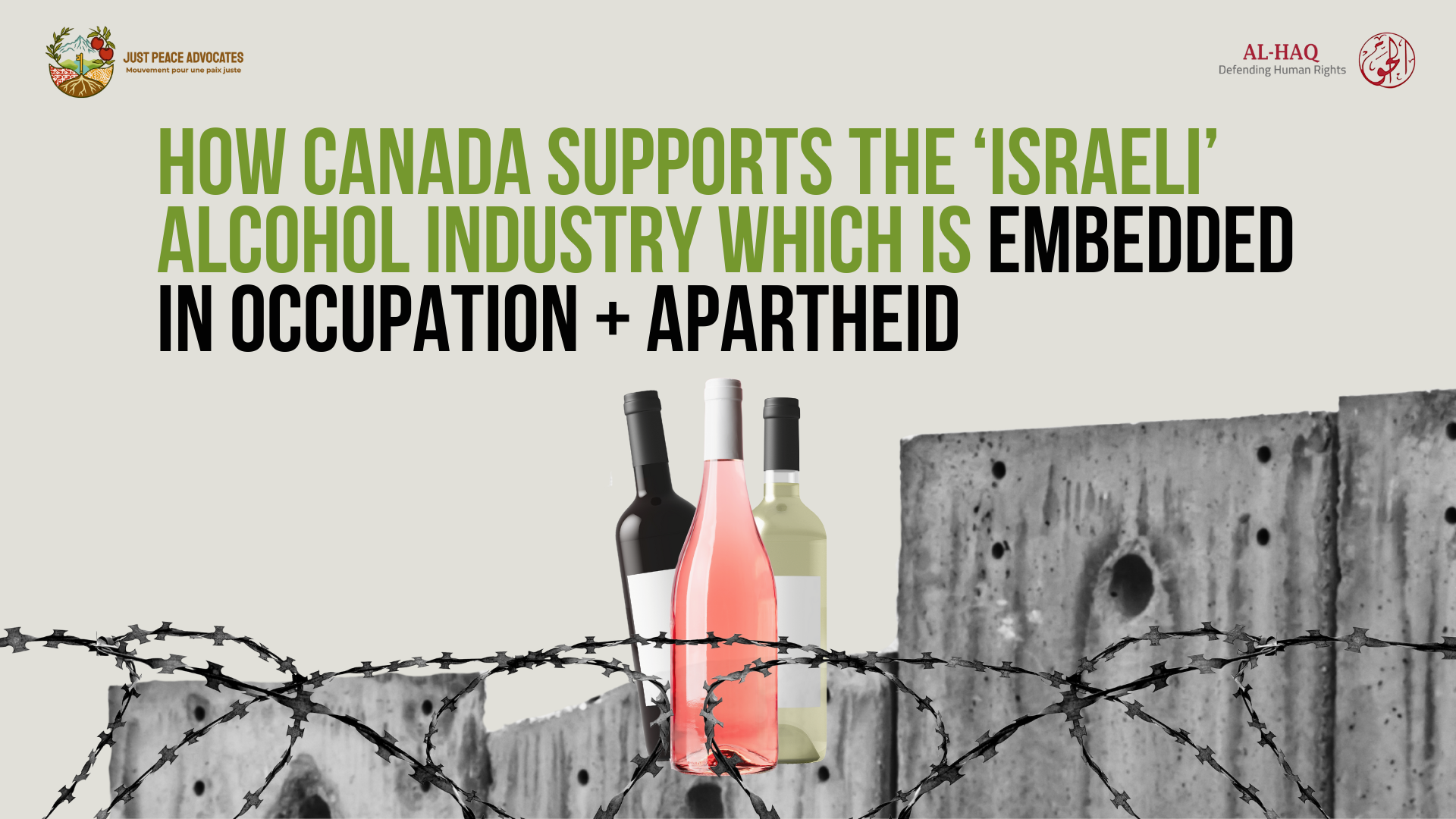
In this new report, Just Peace Advocates and Al-Haq further expose Canada’s complicity in supporting the ‘Israeli’ alcohol industry through the importation and sale of apartheid products.
Introdution
While Americani and Russianii alcohol is removed from Canadian shelves, ‘Israeli’ products continue to be imported and sold without opposition. This is despite Israel’s well-documented and longstanding genocide, apartheid, and unlawful occupation. The ‘Israeli’ alcohol industry is deeply connected to these crimes. Without Israel’s settler colonization of Palestine –– its forced transfer of the Palestinian population, transfer in of Israeli Jewish settlers on lands appropriated from the Palestinian people, its denial of the Palestinian right of return, maintained by a regime of institutionalised racial discrimination and Israeli Jewish domination –– ‘Israeli’ wines would not exist. ‘Israeli’ products are the result of historical and ongoing war crimes, crimes against humanity, and genocide. Yet, Canada continues to facilitate the import of these items.
In Canada, each province and territory has its own regulating authority responsible for alcohol trade.iii Individuals or entities that want to import alcohol (i.e., non-Canadian products) must do so through an agent. Agents typically have to be registered with the province and the provincial authority. Agents are then authorized to solicit / receive orders. More broadly, import of alcohol is governed by the Importation of Intoxicating Liquors Act.iv Canada Border Services Agency (CBSA) also intermittently releases memos regarding the “Commercial Importation of Intoxicating Liquors.” In addition, the Canadian Food Inspection Agency (CFIA) and Global Affairs Canada (GAC) also play significant roles in the importation of alcohol. CFIA oversees identity and labelling requirements through the Food and Drugs Act and Regulations and the Excise Act and Regulations. Wine is also subject to the Consumer Packaging and Labelling Regulations.
In our experience, provincial agencies defer to the CFIA regarding labelling requirements. For instance, while importing Taybeh products — a producer of Palestinian alcohol located in the West Bank — through the Liquor Control Board of Ontario (LCBO), the products were put on hold due to ‘labelling issues’. LCBO requested guidance from the CFIA on whether the Taybeh products could be sold with “Product of Palestine” labels. This occurred while the CFIA allowed the sale of wines from illegal settlements in the occupied West Bank and Syrian Golan labelled as “Product of Israel.”v The LCBO approved “Product of Palestine” labelling in March 2019. However, in August 2019 (after the Kattenburgvi case), they consulted the CFIA and kept Taybeh products on hold until January 2020, when the federal government approved “Product of West Bank” stickers.
In response to Kattenburg, the CFIA held a consultation process asking stakeholders the following question: “For food products from contested territories, would having the geographic region or territory where the food product was produced noted on the label help clarify where the product came from so that the label is not considered ‘false or misleading’ under Canadian labelling regulations?”vii
Just Peace Advocates’ submission to this CFIA consultation process stated:
We are concerned that this consultation, as it a part of considering the relevant provisions of the Food and Drugs Act, Food and Drug Regulations and Consumer Packaging and Labelling Act, would seem to neither intend to implement Canada’s international obligations nor the question of Israel’s occupation of Palestinian or the Syrian Golan territory. Rather, this consultation seems to be just generally looking at labelling without even specifically indicating the territory is occupied (not contested) and has in its scope indicated it will not consider Canada’s own foreign policy which aligns with international law.viii
The Kattenburg case focused on two wineries, Psagot (acting agent: Mazel Wines) and Shiloh (agent not identified). Neither of these wineries currently have products in Canada, and to our knowledge have not since the court case. Despite that, Canada continues to allow the importation and sale of alcohol from occupied territories. This is not simply an issue of ‘labelling.’
Why does it matter?
There are a multitude of impacts on Palestinians and Syrians, both because of companies operating in occupied territory where Israel is unlawfully present (the Occupied Palestinian Territory and Syrian Golan), and also those operating within Israel, where Israel applies a discriminatory apartheid regime on both sides of the Green Line. While only a fraction of the impacts, we’ve outlined some key consequences below.
Land appropriation
In Kattenburg, Munif Treish provided a detailed affidavit articulating the intricacies of one winery’s impact on Palestinian landowners.ix Treish showed that the land occupied by Psagot winery, is in fact the land of 18 Palestinian owners – including Treish’s family. While he can see the Psagot winery from Al-Bireh, Treish is unable to access the land, let alone cultivate, build, or live on it. The Psagot settlement is surrounded by an electric fence, and any attempts to cross without the approval of the Israeli military puts Palestinians at risk of death.x
In the occupied Syrian Golan, Israel confiscates land for “security purposes” and then encourages Jewish-Israeli settlement.xi For instance, Israel seized Mr. Maziad Masoud’s land in the 1980s. When he protested by standing on his land, he was arrested. Despite being released 24 hours later, he only received back 15 of his 40 dunams of land. The “Israeli government has failed to return Mr. Masoud’s land or to clear the landmines surrounding his orchard, which is an ongoing violation of his right to freedom of movement and to the use of his land.”xii Israel makes it “almost impossible for Syrian Arabs to obtain the necessary permits to build houses in the occupied Syrian Golan.”xiii
By confiscating land, restricting building permits, and simultaneously encouraging the establishment of Israeli wineries on occupied land, Israel discriminates against Palestinians and Syrian Arab residents, denying their inalienable right to self-determination.
Exploitation of natural resources
The Israeli government has intentionally facilitated settlement and the exploitation of natural resources, particularly in the occupied Syrian Golan. They have intentionally incentivised Jewish-Israeli settlers to move to the occupied Syrian Golan and facilitated the establishment of wineries on appropriated land.xiv For example, in 2015, 90 Israeli families moved to the occupied Syrian Golan under the “Farms Projects” program which established 750 new farms.xv As part of this project, Israel “illegally diverted water to irrigate those farms, thereby depleting water resources and depriving Syrians of their use.”xvi The exploitation of water resources results in Syrian’s inability to sustain an agricultural economy, despite that agriculture has historically been their main source of income.xvii The practical reality is that Syrian farmers’ are deprived of their use of water, and therefore their ability to sustain themselves. As of 2018, 95% of land in the occupied Syrian Golan was controlled by Israeli settlers, Israeli military, and Israeli authorities.
Entrenchment of Israeli occupation and apartheid
A study from Be’er Sheva University found that “Arab town requests for master plan expansions take up to three times as long as a comparable Jewish town[s]…since 1967, land expansion in the Occupied Golan has been strictly limited to Jewish-Israeli settlers; while 34 new Jewish settlements have been erected, not one meter has been allocated to the [Syrian Arab people], not for public projects or new neighborhoods.”xviii Businesses, including wineries like the Golan Heights Winery, are encouraged to establish themselves in the occupied Syrian Golan to “maximize their access to resources and potential for profit.”xix
Israel also impedes Syrian Arab residents’ right to travel. As Al Marsad explains, “As a people under occupation, most Syrians have resisted Israel’s attempts to force its citizenship onto them. Consequently, many Syrian Arabs in the Golan are not citizens of any country. Instead, they have “undefined” citizenship and are granted a “laissez-passer” to travel. Most Syrian Arab residents of the Golan have permanent residency status. This residency, however, may be revoked under certain conditions.”xx
At the same time settlement wineries are promoted as tourist destinations. “The Israeli government prospers from the Occupied Golan’s natural beauty by offering economic incentives to Israeli settlers for the development of tourism facilities.”xxi Israel’s Ministry of Tourism favours Jewish-owned hotels and prioritizes monthly vouchers for military personnel and veterans with disabilities.xxii Meanwhile, Syrian Arab residents do not have their own freedom of movement.
While Israeli settlers are given preferential treatment and access to resources, under Israel’s entrenched settler colonial apartheid regime, Palestinian farmers are routinely targeted by the Israeli military and settlers. Mahmoud Tawfiq Qasim Faqua spoke to Al-Haq about the daily violations faced by Palestinian farmers in the northern Jordan valley. Mahmoud, who lives in a village near the city of Tubas, told Al-Haq that these springs “are considered the lifeline here and the main source of irrigation for agricultural crops for hundreds of dunums here, where most of the agriculture depends on the water of springs”. Accompanied by the Israeli military, settlers “began cleaning the impurities and weeds that grow around these springs”, which were seized by the settlers, repeating a pattern observed by Mahmoud:
These springs are coveted and the focus of the settlers’ attention, as happened with the various Palestinian springs from earlier, especially Ain al-Sakut, Ain Ghazal and Ain al-Hilwa. . . . [A]ll these springs were controlled and fenced by the settlers and they placed chairs, benches and tables in their surroundings and made these springs a park for them. Indeed, at the end of February and the beginning of March of this year (2023), a large Israeli bulldozer came to the water springs surrounding us and cleaned them of impurities and weeds and also cleaned the surrounding lands . . . [T]hen later a group of settlers came and set up seats, chairs and tables and prepared sessions for camping and sitting there, in addition to wooden boards placed adjacent to the springs so that the settlers can swim in these springs. The springs I am talking about are, as I mentioned, we use the water flowing from them in the field of agriculture, and the spring that I benefit from in particular is called Ain Qaraan, which irrigates my agricultural land of about 50 dunams, in addition to land belonging to another farmer who is also my neighbour, with an area of about 150 dunams.
On 3-4-2023, dozens of vehicles belonging to settlers are present in this area for recreation…However, the settlers’ presence is not limited to swimming, recreation and hiking only, but since the settlers came to this area, the pumps that I use to pump water from the springs to the farms have been sabotaged more than once, and on one occasion I found one of the containers filled with fuel (diesel) that is used to operate this pump, I found it spilled on the ground and the pump was also overturned and lying on the ground, […] This is all because of the settlers who seek every day to expel me from my land and the farmers around me so that they can move more easily and these springs and the surrounding lands become empty spaces for the settlers and their settlement activities . . . [I]f the settlers manage to control these springs and prevent us from accessing the water, hundreds of dunums will become wasteland and unused and thus come under the control of the settlers since these springs are the only source of water for these crops as I mentioned earlier.xxiii
In another interview, Ahmed Hussein Zuhdi Daraghmeh, whose village is surrounded by the settlements of Mihula and the Shadmot Mihula, stated that on 9 September 2023, masked Israeli settlers came to his farm and tried to steal his herd. He described the scene as follows:
As soon as I noticed the attempt to steal these cattle, I walked towards them and tried to prevent them from stealing the cattle and shouted at them to prevent them from stealing the cattle […] part of them approached me and started harassing me, but one of the settlers hit me on my left hand with an iron stick, and repeatedly hit me with that stick on my left hand and my left leg, then I felt that my injury was severe, as I slowly started to feel severe pain until I sat on the ground.xxiv
And yet, the impacts are not isolated to the occupied West Bank and Syrian Golan, as is demonstrated below.
An audit of ‘Israeli’ alcohol products across Canada
This audit is a follow-up to our previous analysis in 2019 and 2021, which found very similar results.
This year, we identified 169 unique items for sale as “Products of Israel” across British Columbia, Alberta, Saskatchewan, Manitoba, Ontario, and Quebec. The remaining provinces did not list any ‘Israeli’ products, while the territories source their products from provincial regulators (e.g., LCBO).
- The main import, by far, was red wine (accounting for 63% of all products). This is followed by white wine (18%), liquor/spirits (13%), rose (4%), sparkling wine (1%), and beer (0.5%).
- Of the wines, 51% are from Galilee, 22% from the Hebron Mountains (including the occupied West Bank), 11% from the occupied Syrian Golan, and 8% from the Beit Shemesh area. The remaining 10% could not be identified as per its origin.xxv
- A total of 25 brands were identified, though some of these entities share parent companies. We highlight some key information about the various companies below.
- Finally, the majority of products were imported by four agents: IsraVin Inc (11%), 81750 Canada Ltd (14%), International Wine Cellars (15%), and Azureau Wine Agency (23%).
You can find a full list of products identified in our audit below.
Company highlights
The Central Bottling Company
Tabor Winery is owned by The Central Bottling Company (Coca Cola Israel). They produce wine with grapes from occupied land in the West Bank and Syrian Golan.xxvi Specifically, Tabor has vineyards in the illegal settlements of Alon Shvut and Gush Etzion in the West Bank, and the Ortal and Keshet settlements in the occupied Syrian Golan.xxvii
Hazi Hinam
Binyamina Winery, owned by Hazi Hinam,is a private winery that has changed ownership over the years. But, as they explain on their website, all have “viewed the winery as an Israeli treasure where agriculture, industry and Zionism converged.”xxviii In addition to sourcing grapes from Galilee, Binyamina has three vineyards in the occupied Syrian Golan: Tel Phares, Kidmat Tzvi, and Mevo Hama.xxix
Binyamina Winery also produces Sabra Liqueur. Sabra uses Jaffa orangesxxx to make its Chocolate Orange liqueur,xxxi which is sold by the LCBO and la Société des alcools du Québec (SAQ; Quebec’s provincial regulator).
Golan Heights Winery
Golan Heights Winery and its subsidiary, Galil Mountain Winery, represent nearly 30% of all products identified in this audit. Golan Heights Winery is located in the occupied Syrian Golan along with 96% of its vineyards.xxxii They also act as a nursery of grapevines for other Israeli wineries through the French company ENTAV-INRA.xxxiii The winery was established in 1983 “by four kibbutzim and four moshavim (cooperative communities).” They currently have 630 hectares of grape-yielding vineyards, which includes 20 grape varieties in 28 vineyards, all of which are in the occupied Syrian Golan.xxxiv
Carmel Winery
Carmel Winery (SCV Grandes Caves Carmel) is one of the largest Israeli wineries and owner of Vitkin Winery. As the first winery established in what is now the State of Israel, Carmel is clear that the “story of Carmel Wineries is the story of the history of the settlement in the Land of Israel, the story of the vision and its fulfillment, the creation of today’s existence from the nothingness of the 19th century. The story of hundreds of winegrowing families who, out of an uncompromising love for the Land of Israel, dreamed of creating a Zionist enterprise here.”xxxv Carmel Winery has produced “wine for 140 consecutive years, without skipping a vintage year, under Ottoman rule, the British Mandate and the State of Israel, during both world wars, during the times of unrest, the Intifada and all of Israel’s wars.”xxxvi Between 2011 and 2015, Carmel collaborated with a settlement agricultural research and design institute in the occupied West Bank.xxxvii They also source many of their grapes from the occupied Syrian Golan.xxxviii
Vitkin Winery’s vineyards are located throughout the occupied territory, including in the “Jerusalem Mountains” and the occupied Syrian Golan.xxxix
Teperberg Winery
Teperberg Winery, originally known as Efrat,xl was established in the late 1800’s. In their own words, [t]he winery, built within the walls of Jerusalem, was the expression of Jewish revival in the Land of Israel and grew to become a strong and prosperous winery, despite the many difficulties that characterized the period.”xli Teperberg openly states they have vineyards in three West Bank areas: “The Samarian Mountains” and the illegal settlements of Gush Etzion and Mevo Horon.xlii
Tishbi Estate Winery
Tishbi Estate (also known as Habaron Wine Cellars) has vineyards in the OPT and occupied Syrian Golan. Specifically, it uses grapes from the illegal West Bank settlement of Migdal Oz and owns over 110,000 square meters of vineyards in the occupied Syrian Golan.xliii They also hold shares (8%) in Gush Etzion Winery which was established in partnership with Tishbi Estate and is located in the occupied West Bank.xliv Notably, SAQ explicitly recognizes one of the Tishbi Estate products they sell as originating in “Judean Hills, Gush Etzion.” Gush Etzion, is a “settlement bloc”xlv between Bethlehem and Hebron. Not only was Gush Etzion one of the first settlements after 1967, it also continues to expand though illegal land grabs.xlvi
In summary:
Five companies explicitly have vineyards in the occupied West Bank: Tabor (Gush Etzion), Barkan (Jersualem Mountains), Teperberg (Gush Etzion, Samarian Mountains, and Mevo Horon), Binyamina (Gilboa), and Tisbhi Estate (Gush Etzion).
Seven companies explicitly have vineyards in the occupied Syrian Golan: Recanti (Odem and Kidmat Tzvi), Odem (Odem and Vineyard 1060), Vitkin (Syrian Golan), Tabor (Ortal and Keshet), Binyamina (Mevo Hama, Tel Phares, and Kidmat Tzvi), Golan Heights Winery (Avital, Ortal, Bar’on, Odem, Hermonit, Ein Zivan, El Rom, Allone Habashan, Yonatan Springs, Yonatan, Geshur, and Tel Phares), and Tisbhi Estate (Syrian Golan).
To see a map with all vineyards, check out maphub.net/JPA/wineries-and-distilleries
A broader issue
The issue is not simply about the officially occupied territory. Other wineries and breweries are established on annexed Palestinian land and appropriate Palestinian resources, furthering Israeli apartheid.
Al-Ras al-Ahmar
Al-Ras al-Ahmar was a village located north of Safad, with a population of approximately 710 Palestinians in 1948.xlvii “In the late nineteenth century, travellers described al-Ras al-Ahmar as a stone village situated on a high hill on which the villagers maintained gardens.”xlviii In the early 1940’s, residents planted 350 dunams of olive trees, with 4,728 dunams allocated for cereals, and 1,008 dunums irrigated or used for orchards.xlix However, in 1948, Operation Hiram – as part of the Nakba – forced the mass displacement of Palestinians from Al-Ras al-Ahmar. Archival material confirms that the Israel military issued orders to “clear the Galilee of Arabs.”l The violence of Operation Hiram was documented by Zionist’s themselves; for example, Yossef Vashitz who joined the Palmach – “an elite branch of the Haganah, a Zionist military organization representing the majority of the Jews in Palestine after World War I.”li In Vashitz’s writings, he documented their violence and brutality against Palestinians in Safsaf, al-Jish, Ein Zeitun, Bir’im, Sasa, Ilabun, Malha, and Mashad. The horrendous and vile physical and sexual violence was “the rule and not the exception.”lii Within a year, an Israeli settlement – Kerem Ben Zimra – was established around, if not on top of, al-Ras al-Ahmar.liii
Now, there are three wineries in the settlement of Ben Zimra, with another 11 within an approximately 10 kilometre radius. Within that same geographic area, approximately 24 Palestinian villages were forcibly transferred and denied their right of return, with countless more in the surrounding areas and throughout all of Palestine.liv Four of the companies identified in our audit as “Products of Israel” are located in this area – Or Haganuz Winery, Galil Mountain Winery, Adir Winery, and Dalton Winery.
This story is one of many, and is evident in the story of Ashkar Winery, a Palestinian company. The Ashkar family produced wine for generations in Iqrit, a small village in the Acre district (now the Upper Galilee). That was, until the village residents were forcibly displaced and the village destroyed in the Nakba in 1948.
In 1951, in response to a plea from the Iqrit villagers, the Israeli Supreme Court ruled that the former residents of Iqrit be allowed to return to their homes. However, before that happened, the IDF, despite awareness of the Supreme Court decision, destroyed Iqrit. Descendants to this day maintain an outpost in the village church, and bury their dead in its cemetery. All attempts to cultivate its lands are uprooted by the Israeli Land Authorities.lv
The family reestablished their winery in 2010 in Kufur Yasif. Nemi Ashkar said:
When I saw more and more vineyards being planted around Iqrit, I felt as if I was pierced by iron nails” he said. “I believed that if I were to make wine, it must come from its marvelous vineyards. I knew I could bring in grapes from many other places, but I found no salvation in doing so. Indeed, I believed that salvation is to be found in wholesome work in a beloved land; and Iqrit is my beloved land, precisely because it is my homeland. Everywhere else I feel an exile, but in Iqrit I always feel at home. Ashkar Winery is only another step in my struggle for fulfillment. My object in life is to have a publicly recognized and legally secured way of returning to Iqrit and there re-build the winery.lvi
These lands, which were illegally appropriated through war crimes, crimes against humanity and genocide now provide economic benefits for Israeli settlers and the State of Israel. Canada is involved in this process by not only allowing the importation of these products, but facilitating it. Meanwhile, as mentioned previously, Canada makes the import of Palestinian products from the OPT near impossible.lvii
Agent highlights
In many cases, there is limited information about agents, who are the conduit. However, three of the agents identified in the audit warrant some consideration.
Agence PF
While importing a very small amount privately through the SAQ, Agence PF is notable because their director is none other than former Deputy Minister of Finance (2014 to 2020) Paul Rochon. It appears as though he and colleagues are importing wine for Société de Vin Œnosphere Inc.
Société de Vin Œnosphere Inc (“Œnosphere”)is a Quebec owned manufacturer that has privately imported wines from Israel to sell under various brand names.lviii There is no way to purchase the products directly online, however, they are being advertised by @mtlwinegal on Instagram. The face of this account is Isabelle Rochon, whose father, Paul Rochon, is a co-owner of Œnosphere with France Lamoureux. Over the last two years, Œnosphere has imported four products under three different brand names: Bashert, Vin Chai, and Vin Golda. Each of these brand names is listed on the Index of Names from the Quebec business registry. The two former brand names have been active since October 7, 2021; the latter since May 18, 2023. In addition, they are selling one product under the brand name “Kvell” which has been active since October 7, 2021.lix
Simcha Wine Corp
It appears as though Simcha Wine Corp is solely responsible for importing products to Ontario from Dalton Winery. While little information is available on Simcha Wine, there are three names that come up as related to the business. David Bitton is listed as the Senior Analyst on LinkedIn,lx Joseph Bitton as Key Principal on Dun & Bradstreet,lxi and Janet Klugsberg as contact person on Wine Align.lxii While we have been unable to confirm these are the same individuals, each individual’s name is associated with various registered charities, including some pro-Israel organizations
- A David Bitton is listed as the director at The Joe Dwek Ohr Haemet Sephardic School and President of The Institut de la Pensée Juive et Communautaire.lxiii
- A Joseph Bitton is listed as the past president of Canadian Magen David Adom for Israel, as well as director at Rachel Bitton Charitable Foundation, Vice-President of Yismah Moshe Hevraj Pinto Charitable Society of Ontario, and director J&J Bitton Family Charitable Foundation.lxiv Canadian Magen David Adom for Israel sends funds directly to Magen David Adom in Israel which provides medical support for the Israeli military.lxv
- A Janet Klungsberg is listed as the Executive Director at the Canada-Israel Cultural Foundation (CICF).lxvi In 2024, CICF sent $216,300 directly to Israel.lxvii
Azureau Wine & Spirits:
The main importer of wine from Israel across Canada is Azureau. The company is led by Dan Rabinovitch. While currently an Ontario registered business, initially, Rabinovitch had registered it as a federal company, but it was dissolved in 2012 for non-compliance (Business Number 848671814RC0001). In July 2025, Rabinovitch joined an event at Shaarei Shomayim, “a Modern Orthodox community [in Toronto]” that stands for “the State of Israel.”lxviii Shaarei Shomayim also appears to support the Israeli military, hosting its personnellxix and promoting their insignia in its cemetery marker design guidelines.lxx Further, Rabinovitch is one of the directors of the Bnei Akiva Schools, a registered charity with the CRA.lxxi Bnei Akiva Schools teach students to regard Israel as the centre of their spiritual and religious lives. The schools regularly host events celebrating the Israeli military, bring in active soldiers to speak, and have a plaque honouring alumni who served.lxxii Many graduates spend a gap year in Israel, often attending religious study programs (Yeshiva/Midrasha) affiliated with Bnei Akiva, where some are further encouraged to enlist in the Israeli military.lxxiii The World Bnei Akiva movement operates academies in Israel specifically designed to prepare non-Israeli youth, including Canadians, for Israeli military service.lxxiv
International Cellars Inc
The majority of ‘Israeli’ wine distributed across Western Canada is imported by one company: International Cellars Inc. They are currently importing wines from Golan Heights Winery, Galil Mountain Winery, and Teperberg Winery (including Efrat wines). International Cellars began “working with Israeli wine” in 2007, after their Principal Director – Norman Gladstone – was convinced by an Israeli wine advocate – Rochelle Golumbia.lxxv Golumbia’s view of ‘Israeli’ wine is that “every drop of wine is made from Israeli grapes, grapes grown on land that has produced wine for thousands of years, land that our ancestors walked, evokes a connection for me that defies any kind of logic.”lxxvi Notably, the BC Liquor Distribution Branch specifically approached International Wine Cellars to “help it establish an Israeli wine sector. International Cellars agreed, said Gladstone, on the condition that the wine was placed under an Israeli banner, rather than a kosher banner.”lxxvii While, usually “it is up to a company like International Cellars to go into each and every liquor store to get them to sell their wines.” But, because the BC Liquor Distribution Branch was “so supportive”, they did the “initial introduction to 23 stores.”lxxviii
A note on distributors
In some cases, products are labelled with additional company information. For instance, Carmel Winery’s Cabernet Sauvignon includes “Royal Wine Co. NY, USA”; Dalton Winery’s Cabernet Sauvignon includes information about importers in Italy and Germany; and Tishbi Estate’s Cabernet Syrah states it is “Imported by: Minister of Wines”, a French company. It is not clear whether these products are making their way through other jurisdictions before import to Canada. For instance, Barkan’s Cabernet Sauvignon label includes “Royal Wine Co. NY, USA.” Royal Wine is a New York based company, that was established in 1948.lxxix When asked whether the wine was imported directly from Israel or through the US, the LCBO staff member could not confirm but did say the Port Name listed was Rishon Le Ziyon, suggesting that perhaps it shipped directly to the LCBO from Israel. But this could not be confirmed at the time of writing.
Legal Implications
In Canada, through the interaction between the Crimes Against Humanity and War Crimes Act (CAHWCA),lxxx the Geneva Conventions Act,lxxxi and the Interpretation Act,lxxxii international war crimes are indictable offences under the Criminal Code and are prosecutable within the Canadian legal system. Notably, this applies to “legal persons”, which includes organizations and corporations.lxxxiii Therefore, not only should Israel be held accountable for its crimes, Canada, its agencies, and all Canadian individuals who support the production, shipment, importation, and sale pipeline must be held accountable.
There are several legal violations worth noting. In allowing the entry of goods from an internationally and domestically recognized occupied area, Quebec, Ontario, Manitoba, Saskatchewan, Alberta, and British Columbia, through their legislated regulatory bodies, are in violation of:
The war crime of pillage
Applicable law: Fourth Geneva Convention, Rome Statute, Geneva Conventions Act, CAHWCA
Pillage is defined as a war crime according to the Fourth Geneva Convention, Rome Statute, and the Geneva Conventions Act.lxxxiv According to the ICC Elements of Crimes, the core elements of pillage are:
- The perpetrator appropriated certain property.
- The perpetrator intended to deprive the owner of the property and to appropriate it for private or personal use.
- The appropriation was without the consent of the owner.lxxxv
Therefore, pillage occurs when property (resources) are taken by the occupying power itself, residents of the occupying power, or portions of the population of the occupying power transferred into the occupied territory. In the specific case of wine and other alcoholic products, this means that any land used for vineyards and the water used for irrigation constitute pillage when the inhabitants of the occupied or contested territory are intentionally deprived of their use. Based on the evidence provided, it is clear the elements of the crime are met.
The CAHWCA, holds “every person who conspires or attempts to commit, is an accessory after the fact in relation to, or counsels in relation to, an offence referred to in subsection (1) is guilty of an indictable offence.”lxxxvi This applies both to the respective governments and every member of the supply chain. Those involved in the supply chain include representatives for the winery, provincial and territorial liquor boards who accept these products for sale or private import, agents who are the party responsible for importing international alcohol, and private beverage alcohol establishments which accept these products for sale or distribution. In particular, the agents, as the conduits for importation, must be held individually criminally liable. Without these agents, these illegal products would not be imported. This does not release the provincial regulators, other corporations, government agencies like CFIA, CBSA, or GAC and/or individuals in the chain from responsibility. All parties who can be, should be held fully accountable. This applies to not only to the crime of pillage, but all war crimes and crimes against humanity detailed below.
Failing to differentiate goods from occupied territory in the Canada-Israel Free Trade Agreement
Applicable laws: UNSC Resolution 2234 (2016) and 465 (1980), July 2024 ICJ Advisory Opinion
UNSC Res 2334 requires States to “distinguish, in their relevant dealings, between the territory of the State of Israel and the territories occupied since 1967.”lxxxvii Additionally, UNSC Res 465 calls upon states “not to provide Israel with any assistance to be used specifically in connection with settlements in the occupied territories.”lxxxviii UNSC resolutions are binding on member states, in this case Canada. Therefore, this applies to all federal agencies (CFIA, CBSA, GAC). That being said, the federal government’s failure to abide by international law does not give provincial regulators a free pass. Rather, as the party responsible for the import and sale of alcohol under the Division of Powers, provincial regulators must uphold these resolutions.
In the July 2024 ICJ Advisory Opinion, the Court was clear that neither the Oslo Accords – nor “any agreement” – gives a ‘free pass’ against customary international law-derived responsibilities afforded to an occupied population, particularly under the Fourth Geneva Convention.lxxxix As former Special Rapporteur Michael Lynk clearly articulated: Canada’s public policy stance defers to the Fourth Geneva Convention but it enacts economic policy that directly contravenes customary international law and domestic law.xc
“Through the adoption of [CIFTA], the Canadian government enables the unlawful appropriation of Palestinian resources, including land, water and minerals, to produce goods that are exported and sold for private profit. In doing so, it fails to meet obligation under international law not to recognize as lawful an illegal situation and to not assist its maintenance.”xci
Land appropriation
Applicable law: July 2024 ICJ Advisory Opinion, Fourth Geneva Convention, Geneva Conventions Act, Rome Statute
Article 147 of the Fourth Geneva Convention affirms that the “extensive destruction and appropriation of property, not justified by military necessity and carried out unlawfully and wantonly,” is a grave breach of international law and prosecutable as a war crime.xcii The destruction of public and private property is also a violation of Article 53 of the Fourth Geneva Convention, and the confiscation of property is illegal under Article 46 of the Hague Regulations.xciii
Importantly, the Occupying Power’s administration of public immovable property, is strictly regulated by the rules of usufruct, which limits how the Occupying Power can use public property, prohibiting for example, the exploitation of resources for the benefit of the domestic economy of the Occupying State.xciv The exploitation of public and private resources of the occupied territory beyond permissible requisitionsxcv and usufruct amounts to pillage, a war crime prosecutable under the Rome Statute.xcvi
There is ample evidence of land appropriation and extensive destruction of property in the OPT and occupied Syrian Golan. Legal and human rights organizations like Al-Haq have and continue to document these war crimes.xcvii
By importing alcohol, made by way of produce from land appropriated from the occupied Palestinian and Syrian population, Canadian federal agencies, provincial regulators, agents, and any other distributors are complicit in aiding and abetting the commission of war crimes, including the appropriation and pillage of land and natural resources.
Transfer of civilian population
Applicable law: Fourth Geneva Convention, Rome Statute, Geneva Conventions Act
The 2012 UN Fact-Finding Mission established that “business enterprises have, directly and indirectly, enabled, facilitated and profited from the construction and growth of the settlements”.xcviii Based on the evidence, it is clear that these wineries contribute to the maintenance and expansion of Israel’s illegal settlements. The practice of forcible transfer is specifically prohibited during a military occupation. Article 49(6) of the Fourth Geneva Convention states that “the Occupying Power shall not deport or transfer parts of its own civilian population into the territory it occupies.”xcix The Occupying Power also “shall not deport or transfer parts of its own civilian population into the territory it occupies,” whether directly or indirectly.c “Indirect support or encouragement may include building roads leading to settlements, providing military security for settlements, supplying electricity or offering tax incentives relative to nationals living in the Occupying Power’s own territory.”ci These laws are reflected in the Rome Statute articles 7(d) and 8(2)(b)(viii).
Israel violates these laws both through the forced displacement of Palestinians and the transfer of its own civilian population into the territory it occupies. As outlined in an earlier section of this report, Israel incentivizes and facilitates settlement in the occupied Syrian Golan through initiatives like the “Farm Project.” In the OPT, Israel forcibly displaces Palestinians to transfer in its own civilian population, thereby expanding illegal settlements.cii
The crime of apartheid
Applicable law: July 2024 ICJ Advisory Opinion, International Convention on the Elimination of All Forms of Racial Discrimination (CERD), Geneva Conventions Act
The ICJ highlighted widespread systemic violations including legislation regarding the limited issuance of residential permits in East Jerusalem,ciii restrictive permitting regimes within the West Bank,civ punitive demolitions of Palestinian property,cv and systemic restrictions on access to building permits and planning committees.cvi Based on this, the ICJ found that the differentiation of treatment between Palestinians and Jewish residents in the occupied territory “cannot be justified with reference to reasonable and objective criteria nor to a legitimate public aim.”cvii
The ICJ therefore determined that this systemic discrimination amounted to a breach of Article 3 of the International Convention on the Elimination of All Forms of Racial Discrimination (CERD), which states: “States Parties particularly condemn racial segregation and apartheid and undertake to prevent, prohibit and eradicate all practices of this nature in territories under their jurisdiction.”cviii
Israeli settlements, whether residential, agricultural, industrial or in the form of tourist sites, have fragmented and altered the demographic composition of the occupied Palestinian territory. This undermines Palestinian territorial integrity and impedes the Palestinian people’s right to self-determination which encompasses the right to permanent sovereignty over land and natural resources.cix Due to Israeli-imposed constraints, movement restrictions, and physical obstacles, particularly those associated with the settlement enterprise, Palestinians are often denied access and control over their land and property (both public and private), thus infringing upon their social, economic, and cultural rights. This naturally has negative consequences on Palestinian livelihoods and further contributes to the de-development of the Palestinian economy.
Furthermore, dispossession and displacement of Palestinians are key features to Israel’s settlement enterprise, with Palestinian land and property regularly being subject to confiscation and demolition, as part of the wider Israeli discriminatory planning and zoning policies favouring the development of Israeli-Jewish settlements on occupied Palestinian land. Israel’s prolonged occupation and colonisation has created a deeply entrenched regime of systemic and institutionalized discrimination, segregation, and fragmentation against Palestinians on both sides of the Green Line, amounting to the crime of apartheid.cx
By privileging the Israeli-Jewish settler population, the Israeli state has facilitated the expansion and growth of illegal settlements and associated infrastructure, further incentivizing settlers.cxi It should be noted that settler violence against Palestinians is a feature of Israel’s occupation and settlement enterprise, manifested in various forms such as verbal and physical attacks, harassment, forced evictions, destruction and vandalizing of property – at many times, happening under the guise and protection of the Israeli military, and settler perpetrators are not held to account.cxii
Further, the Rome Statute lists apartheid as a crime against humanity. As with the various settlement-specific war crimes listed above, crimes against humanity, as enacted under the CAHWCA, are indictable offences through the Canadian Criminal Code.
The Rome Statute states that apartheid encompasses a variety of “inhumane acts”, which include but are not limited to acts of deportation and forced transfers of populations that take place within the context of “an institutionalized regime of systematic oppression and domination by one racial group over any other racial group or groups and committed with the intention of maintaining that regime.”cxiii
As described by Human Rights Watch:
Israeli authorities have carried out a range of inhumane acts in the OPT. Those include sweeping restrictions on the movement of 4.7 million Palestinians there; the confiscation of much of their land; the imposition of harsh conditions, including categorical denial of building permits in large parts of the West Bank, which has led thousands of Palestinians to leave their homes under conditions that amount to forcible transfer; the denial of residency rights to hundreds of thousands of Palestinians and their relatives, largely for being abroad when the occupation began in 1967, or for long periods during the first few decades of the occupation, or as a result of the effective freeze on family reunification over the last two decades; and the suspension of basic civil rights, such as freedom of assembly and association, depriving Palestinians of the opportunity to have a voice in a wide range of affairs that most affect their daily lives and futures. Many of these abuses, including categorical denials of building permits, mass residency revocations or restrictions, and large-scale land confiscations, have no legitimate security justifications; others, such as the extent of restrictions on movement and civil rights, fail any reasonable balancing test between security concerns and the severity of the underlying rights abuse.cxiv
Aiding + Abetting
Applicable law: Criminal Code
Section 21 of the Canadian Criminal Code defines aiding and abetting as such: “[E]veryone is party to an offence who (a) actually commits it, (b) does or omits to do anything for the purpose of aiding any person to commit it or (c) abets any person in committing it.” As expressed in R v Briscoe,cxv proof of pre-knowledge and intent are central to successful criminal prosecutions of aiding and abetting. Therefore, corporations and individuals who use their expertise toward the development and/or entrenchment of settlement-related infrastructure (e.g., vineyards in the occupied West Bank) is aiding and abetting, with no plausible defence against a priori knowledge of secondarily liability. This is because both the July 2024 ICJ Advisory Opinion and Canadian public policy are clear that settlements in the OPT are illegal. The potential for corporate profit does not excuse violations of international and domestic laws. Some of the relevant criminal acts that could apply — based on the testimonies from Palestinian land owners and farmers — include bodily harm and acts and omissions causing danger to the person (Article 244), assault (Article 264.1), kidnapping, and abduction (Article 279), and theft (Article 322).
Laundering Proceeds of Crime
Applicable Law: Criminal Code
Canadian companies (including provincial agencies, private companies, and potentially agents) are deriving profit from settlement-produced goods and services. As mentioned, civilian settlements created by the Occupying Power in occupied territory are war crimes under the CAHWCA. Given that the proceeds of an unlawful civilian settlement – which are the proceeds of war crimes under international and Canadian law – are themselves also unlawful, we argue that those who profit, benefit or gain by them (through the selling of settlement units, the selling of settlements goods and services, etc.) are trading unlawfully.
We argue that these instances of unlawful trading constitute the criminal offence of ‘laundering proceeds of crime’. Section 462.31 (1) of the Criminal Code defines laundering proceeds of crime as such:
Every one commits an offence who uses, transfers the possession of, sends or delivers to any person or place, transports, transmits, alters, disposes of or otherwise deals with, in any manner and by any means, any property or any proceeds of any property with intent to conceal or convert that property or those proceeds, knowing or believing that, or being reckless as to whether, all or a part of that property or of those proceeds was obtained or derived directly or indirectly as a result of
(a) the commission in Canada of a designated offence; or
(b) an act or omission anywhere that, if it had occurred in Canada, would have constituted a designated offence.
It must be noted that war crimes, while prosecutable under domestic law in Canada, have no specific designation under the Criminal Code itself. As such, war crimes are not listed among the dozens of primary and/or secondary designated offences found under Section 752 of the Criminal Code, and to which the laundered criminal proceeds must be attached. What is required, rather, is to parse apart the designated offences that have taken place, in Israel, which underwrite settlement-based war criminality. The deportation and/or transfer of indigenous populations out of unlawfully occupied Palestinian territory, coupled with the importation of civilian, settler, populations, into unlawfully occupied Palestinian territory, is in fact dependant upon – and is continuously maintained by – numerous, well-documented, acts of violence which are designated offences under the Criminal Code. These include using explosives, using firearms in the commission of an offence, pointing firearms, assault, forcible confinement, robbery, attempt to commit murder, and discharging firearms.
Jurisdiction
All of this rests on the assumption of jurisdiction. Both Canadian and international law are applicable in this situation. As noted above, Canada has ratified various customary international legal frameworks, specifically the Rome Statute and the Fourth Geneva Convention, into Canadian domestic law. The CAHWCA and the Geneva Conventions Act, were developed with the express purpose of streamlining domestic legal cooperation in Canada with the International Criminal Court.cxvi As articulated above, acts of war criminality therefore are not only transgressions of customary international law but are prosecutable within the Canadian legal system. As Al-Haq and the Canadian Lawyers for International Human Rights (CLAIHR) argued in a leave to intervene in Kattenburg, “administrative decision-makers must interpret legislation using a presumption that such laws conform with Canada’s obligations under conventional and customary international law and the values and principles underlying these sources.”cxvii While Canada has a dualist legal system, its incorporation of international law into domestic law cannot be relied upon in a way that violates Canada’s international obligations. By not only allowing, but facilitating the important of products from occupied territories, provincial regulators have breached its responsibility as described in Vavilov.
Further, regarding corporate complicity, Canada is legally bound by the ‘doctrine of adoption’ which means that barring the presence of conflicting domestic legislation, customary international law is to be adopted into the domestic legal sphere.cxviii This applies even in the absence of applicable domestic legislation.cxix Bil’in, a case central towards attempting to apply domestic law against alleged Canadian corporate complicity in Israeli war criminality in the West Bank,ultimately resulted in a dismissal over jurisdiction. The Bil’in decision, however, also contained two key determinations. Firstly, the SCC made clear that a legal person engaged in a war crime might be found at fault under Canadian civil law.cxx Secondly, Bil’in made clear that determinations of domestic jurisdiction were based upon various and variable factors. That the SCC declined to exercise jurisdiction over Québec-based defendants allegedly engaged in Israeli war crimes was the exception, rather than the rule, with each case to be measured in turn.cxxi
Both Bil’in and Hape have informed the Supreme Court of Canada’s (SCC) landmark ruling in Nevsun Resources Ltd v Araya.cxxii In Nevsun, the SCC affirmed that private corporations may be liable under Canadian domestic law for breaches of customary international law committed outside of Canada and are not immune from civil suits brought against them by international plaintiffs. Within the sphere of civil law, we interpret Nevsun as a warning to Canadian corporations complicit in Israel’s illegal occupation.
Bonus Highlight: The “Israel Wine Club”
The Israel Wine Club is an offering from Mizrachi Canada, a Canadian registered charity. In their own words:
“With the ideals of Zionism and a genuine Ahavat Israel at the core of Mizrachi’s mission, this club strives to highlight the very best wines our homeland has to offer. Members can choose from a monthly trial, a six-month or full year membership. Subscriptions come with the maximum allowable charitable tax receipt. Once signed up, you will receive a curated box of wine every other month, themed by a wine region in Israel or a specific time of year.”cxxiii Every other month, members receive a box of wine from one of 6 regions.
This expands the complicity of the Canadian government to the Canadian Revenue Agency (CRA). By providing tax receipts for the purchase of Israeli wine, the CRA is not only allowing the use of tax-subsidized funds for illegal settlements, Israeli military support, and the blocking humanitarian aid to Gaza,cxxiv they are also implicating tax payers in the crimes outlined above.
Demands
Immediately end the importation and sale of all Israeli wine, in alignment with international and domestic law.
More Information
Locations are estimates based on publicly available data. In many cases exact location is not provided by the winery. This represents our best estimate.
Notes
i Alex Arsenych Lavoie Joanna, “LCBO halts U.S. liquor sales to all stores, restaurants, grocers and bars”, CTVNews (3 February 2025), online: <https://www.ctvnews.ca/toronto/article/lcbo-halts-us-liquor-sales-to-all-stores-restaurants-grocery-and-bars/>.
ii CBC, “Ontario tells LCBO to pull all Russian-made products from store shelves”, CBC News (25 February 2022), online: <https://www.cbc.ca/news/canada/toronto/ont-liberal-lcbo-1.6364570>; “helloLCBO | Russian products removed from LCBO sales channels”, online: <https://hellolcbo.com/app/answers/detail/a_id/3132/~/russian-products-removed-from-lcbo-sales-channels>.
iii This article provides a brief overview of alcohol sale rules by province.
iv Government of Canada, Importation of Intoxicating Liquors Act, RSC 1985, c I-3Last Modified: 2021-04-01.
v Palestine Just Trade, “Taybeh is HERE, but on HOLD by LCBO as Directed by the Canadian Food Inspection Agency (CFIA)” (29 August 2019), online: Palestine Just Trade <https://palestinejusttrade.ca/taybeh/taybeh-is-here-but-on-hold-by-lcbo-as-directed-by-the-canadian-food-inspection-agency-cfia/>.
vi Kattenburg v Canada (Attorney General), 4 FCR 747.
vii Canadian Food Inspection Agency, “Consultation on origin labelling of imported foods from a contested territory” (10 July 2023), online (Reference material): <http://inspection.canada.ca/en/about-cfia/transparency/consultations-and-engagement/completed/origin-labelling-imported-foods-conteste/origin-labelling-imported-foods-conteste> Last Modified: 2023-11-08.
viii Just Peace Advocates, “Just Peace Advocates submission to the CFIA Origin Labelling Consultation” (7 October 2023), online: Just Peace Advocates <https://www.justpeaceadvocates.ca/just-peace-advocates-submission-to-the-cfia-origin-labelling-consultation/>.
ix Canada (Attorney General) v Kattenburg, [2020] Affidavit of Munif Treish [Kattenburg].
x Ibid at para 54.
xi Observations and Topics to be Included in the List of Issues, by Al Marsad (11 April 2018) at 9 online: <https://golan-marsad.org/wp-content/uploads/2021/01/Al-Marsad-List-of-Issues-UNHRC-submission-for-Israel-April-2018.pdf>.
xii Ibid.
xiii Ibid at 8.
xiv Al Marsad, supra note 11.
xv Report of the Special Committee to Investigate Israeli Practices Affecting the Human Rights of the Palestinian People and Other Arabs of the Occupied Territories, by UN Special Committee, UN Doc A/70/406 (United Nations, 5 October 2015) at para 12 online: <https://documents.un.org/doc/undoc/gen/n15/299/15/pdf/n1529915.pdf>.
xvi Ibid.
xvii Al Marsad, supra note 11 at 6.
xviii Ibid at 4.
xix Ibid at 6.
xx Ibid at 15–16.
xxi Ibid at 7.
xxii Ibid at 7.
xxiii Al-Haq, Affidavit taken from Mahmoud Tawfiq Qasim Faqha, 35, resident of Ein al-Bayda village, on 3 April 2023, on file with Al-Haq.
xxiv Al-Haq, Affidavit taken from Ahmed Hussein Zuhdi Daraghmeh, 33, resident of Ein al-Bayda village, on 16 September 2023, on file with Al-Haq.
xxv Some of the products listed multiple regions. In these cases (3), the product was listed under each relevant region.
xxvi Who Profits, “Tabor Winery”, online: Who Profits <https://www.whoprofits.org/companies/company/4073?tabor-winery>.
xxvii Ibid.
xxviii “About the Winery – Binyamina Winery wines”, online: Binyamina Winery <https://www.binyaminawines.co.il/en/about-us/>.
xxix “Our Vineyards – Binyamina Winery wines”, online: Binyamina Winery <https://www.binyaminawines.co.il/en/our-vineyards/>.
xxx “Fruits of Occupation and Genocide: Boycott Citrus Fruits from the zionist entity” (9 June 2025), online: Canadian BDS Coalition <https://bdscoalition.ca/2025/06/08/fruits-of-occupation-and-genocide-boycott-citrus-fruits-from-the-zionist-entity/>.
xxxi “Sabra Orange Chocolate Liqueur Israel 1970s – Flask”, online: <https://flaskfinewinesclub.shop/sabra-orange-chocolate-liqueur-isreal-1970s/>.
xxxii Who Profits, “Golan Heights Winery”, online: Who Profits <https://www.whoprofits.org/companies/company/4029?golan-heights-winery>.
xxxiii Ibid.
xxxiv “Winery – מהו סיפור היקב, מה החזון ומידע על הכרמים | יקב רמת הגולן”, online: Golan Heights Winery <https://www.golanwines.co.il/en/winery/>.
xxxv “אודות יקבי הכרמל”, online: יקבי כרמל <https://www.carmelwines.co.il/עמוד-אודות/>.
xxxvi Ibid.
xxxvii Who Profits, “Carmel Wineries”, online: Who Profits <https://www.whoprofits.org/companies/company/4213?carmel-wineries>.
xxxviii Ibid.
xxxix “הסיפור של יקב ויתקין”, online: יקב ויתקין <https://vitkin-winery.co.il/אודות/>.
xl Haaretz, “Moti Teperberg and Hila Lieber-Teperberg”, Haaretz (25 November 2011), online: <https://www.haaretz.com/2011-11-25/ty-article/moti-teperberg-and-hila-lieber-teperberg/0000017f-e3ba-d38f-a57f-e7fa340e0000>.
xli “Five Generations of Wine | Teperberg Winery”, online: <https://teperbergwinery.co.il/en/timeline/>.
xlii “vineyards from Zefat to Mitzpe Ramon | Teperberg winery”, online: <https://teperbergwinery.co.il/en/vineyards/>.
xliii Who Profits, “Tishbi Estate Winery (Habaron Wine Cellars)”, online: Who Profits <https://www.whoprofits.org/companies/company/4126?tishbi-estate-winery-habaron-wine-cellars>.
xliv Ibid.
xlv Settlement blocs are not legitimate concepts in international law; however, they are used by Israeli to annex and claim ownership over large swathes of Palestinian land. They are also used to justify Israeli presence by arguing that illegal activity is okay. “Why Israel invented the concept of ‘settlement blocs’”, online: Middle East Eye <https://www.middleeasteye.net/opinion/why-israel-invented-concept-settlement-blocs>.
xlvi “The fraud of Gush Etzion, Israel’s mythological settlement bloc – +972 Magazine”, online: <https://www.972mag.com/the-fraud-of-gush-etzion-israels-mythological-settlement-bloc/>.
xlvii “Palestine Remembered: Satellite View of al-Ras al-Ahmar – الرأس الأحمر, Safad-صفد”, online: <https://www.palestineremembered.com/Safad/al-Ras-al-Ahmar/SatelliteView.html>.
xlviii “al-Ras al-Ahmar — الراس الأحمر”, online: Interactive Encyclopedia of the Palestine Question – palquest <https://www.palquest.org/en/place/16872/al-ras-al-ahmar>.
xlix Ibid.
l “Operation Hiram Revisited: A Correction: Journal of Palestine Studies: Vol 28, No 2”, online: <https://www.tandfonline.com/doi/abs/10.2307/2537935>.
li “Yigal Allon | Labor leader, Knesset member, General | Britannica” (16 October 2025), online: <https://www.britannica.com/topic/Palmach>.
lii “An Indicative Archive: Salvaging Nakba Documents”, online: Institute for Palestine Studies <https://www.palestine-studies.org/en/node/1650358>.
liii note 56; Information cited by Palestine Remembered was sourced from All That Remains: The Palestinian Villages Occupied and Depopulated by Israel in 1948.
liv This includes Harrawi, Mallaha, Arab al-Zubayd, Dayshum, Saliha, Fara, Kafr Bir’im, ‘Alma, Jazayir al-Hindaj, al-Husayniyya, al-Wayziyya, al-Ja’una, Biriyya, Mirun, Mughr al-Khayt, Fir’im, ‘Ayn al-Zaytun, Qaddita, Taytaba, Dallata, Marus, Sa’sa’, and Safsaf. See “Palestine Remembered: Satellite View of Jerusalem – القدس الشريف City, Jerusalem-القدس”, online: <https://www.palestineremembered.com/GeoPoints/Jerusalem_528/SatelliteView.html>.
lv “About Us”, online: Ashkar Winery <https://www.ashkarwinery.com/about-us/>.
lvi Ibid.
lvii For instance, Palestine Just Trade was able to import Ashkar wine much more easily than Taybeh wine and beer. Both companies are Palestinian owned – however, because Ashkar Winery is in the 1967 borders, it was automatically labelled as “Product of Israel” despite being produced by a Palestinian company. In contrast, Taybeh products are produced in the occupied West Bank.
lviii This information was identified via an ATIP to the SAQ in spring 2025.
lix “Our Wines”, online: Œnosphere <https://www.oenosphere.ca/our-wines>.
lx “david bitton – Senior Analyst at Simcha Wine Corp. | LinkedIn”, online: <https://ca.linkedin.com/in/david-bitton-457a8861>.
lxi “Simcha Wine Corp Company Profile | Thornhill, ONTARIO | Competitors, Financials & Contacts – Dun & Bradstreet”, online: <https://www.dnb.com/business-directory/company-profiles.simcha_wine_corp.6da74e94fb3d833e3c9edea32048564f.html>.
lxii “Simcha Wine Corp”, online: WineAlign <https://www.winealign.com/profile/1577>.
lxiii “Director Search Results — Charity Data”, online: <https://www.charitydata.ca/search/director?firstName=david&lastName=bitton&offset=0>.
lxiv “Director Search Results — Charity Data”, online: <https://www.charitydata.ca/search/director?firstName=joseph&lastName=bitton&offset=0>.
lxv “Academic article by Dr. Miles Howe: Tracking Financial Complicity in Israeli War Crimes and Genocide: Instances of Aiding and Abetting in the Canadian Charitable Sector” (16 June 2025), online: Just Peace Advocates <https://www.justpeaceadvocates.ca/academic-article-by-dr-miles-howe-tracking-financial-complicity-in-israeli-war-crimes-and-genocide-instances-of-aiding-and-abetting-in-the-canadian-charitable-sector/>.
lxvi “Canada-Israel Cultural Foundation | UJA Federation of Greater Toronto”, online: <https://www.jewishtoronto.com/directory/canada-israel-cultural-foundation>.
lxvii “2024 Donations: How Canadian charities funneled money to Israel’s occupation, apartheid, and genocide in 2024 News” (4 September 2025), online: Just Peace Advocates <https://www.justpeaceadvocates.ca/2024-donations-how-canadian-charities-funneled-money-to-israels-occupation-apartheid-and-genocide-in-2024/>.
lxviii “Shaarei Shomayim”, online: <https://www.shomayim.org/>.
lxix “Guest Chazzan: Shai Abramson, Chief Chazzan of the IDF & his choir – Event – Shaarei Shomayim”, online: <https://www.shomayim.org/event/guest-chazzan-shai-abramson-chief-chazzan-of-the-idf–his-choir.html>.
lxx “Cemetery Markers – Shaarei Shomayim”, online: <https://www.shomayim.org/cemetery-markers.html>.
lxxi Canada Revenue Agency, “T3010 Registered Charity Information Return : Section B – Directors/Trustees and Like Officials : Review”, online: <https://apps.cra-arc.gc.ca/ebci/hacc/srch/pub/t3010/v27/t3010DrctrsTrstsLkOffcls_dsplyovrvw>.
lxxii Yves Engler, “Toronto ‘charity’ trains students to join the Israeli military” (9 August 2024), online: Mondoweiss <https://mondoweiss.net/2024/08/toronto-charity-trains-students-to-join-the-israeli-military/>.
lxxiii Presstv, “Canadian ‘charity’ high school trains students to serve in Israeli military” (10 August 2024), online (image): PressTV <https://www.presstv.ir/Detail/2024/08/10/731080/Canada-Bnei-Akiva-students-high-school-Israel-military-Gaza>.
lxxiv Engler, supra note 81.
lxxv Cynthia Ramsay, “Israeli wines now available” (21 December 2007), online: Jewish Independent <https://www.jewishindependent.ca/oldsite/archives/dec07/archives07dec21-01.html>; Rochelle Golumbia, “Rochelle Golumbia” (12 July 2024), online: <https://www.jewishindependent.ca/byline/rochelle-golumbia/>.
lxxvi Cynthia Ramsay, supra note 83.
lxxvii Ibid; Lauren Kramer Correspondent Pacific, “Israeli wines available in Vancouver” (11 February 2010), online: The Canadian Jewish News <https://thecjn.ca/arts-culture/israeli-wines-available-vancouver/>.
lxxviii Canada Palestine Association, “Wine merchants or war crimes profiteers?” (25 February 2023), online: Mondoweiss <https://mondoweiss.net/2023/02/wine-merchants-or-war-crimes-profiteers/>.
lxxix “About Us”, online: Royalwine <https://royalwine.com/about-us/>.
lxxx Crimes Against Humanity and War Crimes Act, SC 2000, c 24.
lxxxi Geneva Conventions Act, RSC 1985, c G-3.
lxxxii Interpretation Act, RSC 1985, c I-21.
lxxxiii The Criminal Code defines organizations as “(a) a public body, body corporate, society, company, firm, partnership, trade union, or municipality, or (b) an association of persons that is i] is created for a common purpose, ii) has an operational structure, and iii] holds itself out to the public as an association of persons.” Criminal Code, RSC 1985, c C-46 2025, s 2.
lxxxiv Geneva Conventions Act, supra note 86.
lxxxv International Criminal Court, Elements of Crimes, 2013 art 8(2)(b)(xvi).
lxxxvi Crimes Against Humanity and War Crimes Act, supra note 85, s 4(1.1).
lxxxvii UN Security Council (71st year: 2016), ed, Resolution 2334 (2016) (New York: UN, 23) at para 5.
lxxxviii Ibid.
lxxxix ICRC, Convention (IV) relative to the Protection of Civilian Persons in Time of War. Geneva at para 102.
xc Michael Lynk, “Canada’s updated trade agreement with Israel violates international law” (29 May 2019), online: The Conversation <http://theconversation.com/canadas-updated-trade-agreement-with-israel-violates-international-law-117547>.
xci Lysanne Louter, “Amnesty International Canada calls UN list of companies to stop operating in Israeli settlements” (1 June 2020), online: Amnesty International Canada <https://amnesty.ca/features/amnesty-international-canada-calls-un-list-of-companies-to-stop-operating-in-israeli-settlements/>.
xcii Fourth Geneva Convention, supra note 94 art 147 This is reflected in Article 8(2)(iv) of the Rome Statute.
xciii Second Internatioanl peace Conference, Convention (IV) Respecting the Laws and Customs of War on Land and Its Annex: Regulations Concerning the Laws and Customs of War on Land, 1907 art 46 The requisition of private property is allowed only in exceptional cases for the needs of the occupying army.
xciv Ibid art 43,55; Fourth Geneva Convention, supra note 94 art 53,64.
xcv Hague Convention, supra note 98 arts 52–53.
xcvi Ibid art 47; Fourth Geneva Convention, supra note 94 art 33; International Criminal Court, Rome Statute, 2002 art 8(2)(b)(xvi).
xcvii “Field Focus – Forcible Displacement from Jenin Refugee Camp, A Symbol of Return and a Target of Erasure”, online: Al-Haq | Defending Human rights in Palestine since 1979 <https://www.alhaq.org/monitoring-documentation/26433.html>; “Special Focus: On Palestine Land Day, Al-Haq Highlights the Continued Nakba Through Land Registration Aimed at Mass Forcible Transfer”, online: Al-Haq | Defending Human rights in Palestine since 1979 <https://www.alhaq.org/monitoring-documentation/19791.html>; “Field Focus: Strategic Land Theft and Forced Displacement in Al-Makhrour – UNESCO Site Under Threat”, online: Al-Haq | Defending Human rights in Palestine since 1979 <https://www.alhaq.org/monitoring-documentation/26315.html>; “Special Focus: Israel Forces Self-Demolitions in Occupied East Jerusalem”, online: Al-Haq | Defending Human rights in Palestine since 1979 <https://www.alhaq.org/monitoring-documentation/16540.html>.
xcviii Ardi Imseis, ed, “Report of the Independent International Fact- Finding Mission to Investigate the Implications of the Israeli Settlements on the Civil, Political, Economic, Social and Cultural Rights of the Palestinian People Throughout the Occupied Palestinian Territory, Including East Jerusalem” (2014) 17:1 Palest Yearb Int Law Online 219–266, online: <https://brill.com/view/journals/pyio/17/1/article-p219_19.xml> at para 96.
xcix Fourth Geneva Convention, supra note 94 art 49.
c Ibid art 49(6).
ci Commentary to the ibid.
cii “Ethnic Cleansing: An Ongoing Nakba”, online: Makan <https://www.makan.org.uk/hub/explainer/ethnic-cleansing-an-ongoing-nakba/>; note 102; “Al-Haq Issues Briefing Paper on Palestinian Sovereignty over East and West Jerusalem”, online: Al-Haq | Defending Human rights in Palestine since 1979 <https://www.alhaq.org/advocacy/6145.html>.
ciii Legal Consequences Arising From The Policies And Practices Of Israel In The Occupied Palestinian Territory, Including East Jerusalem, 2024 ICJ at paras 192–197 [July 2024 Advisory Opinion].
civ Ibid at paras 198–206.
cv Ibid at paras 208–213.
cvi Ibid at paras 214–222.
cvii Ibid at para 223.
cviii United Nations, International Convention on the Elimination of All Forms of Racial Discrimination, UNGA Resolution art 3.
cix UNHRC, Right of the Palestinian people to self-determination, Res 28/25 9.
cx “A Threshold Crossed: Israeli Authorities and the Crimes of Apartheid and Persecution | HRW”, online: <https://www.hrw.org/report/2021/04/27/threshold-crossed/israeli-authorities-and-crimes-apartheid-and-persecution>.
cxi Ibid.
cxii Ibid.
cxiii Rome Statute, supra note 101 art 7(2)(h).
cxiv note 115.
cxv R v Briscoe, 1 SCR 411.
cxvi “Bill C-19: Crimes Against Humanity Act (LS-360E)”, online: <https://publications.gc.ca/Pilot/LoPBdP/LS/362/c19-e.htm>.
cxvii Submissions of Dr. David Kattenburg to the Canadian Food Inspection Agency (CFIA), by Dimitri Lascaris (2021) online: <https://dimitrilascaris.org/wp-content/uploads/2021/11/kattenburg-submissions-to-cfia-oct-18-2021.pdf>; “Case Update: CLAIHR and Al-Haq et al. seek leave to appeal to Supreme Court of Canada in Kattenburg v CanadaCase on Labelling of Illegal Settlement Products”, online: Al-Haq | Defending Human rights in Palestine since 1979 <https://www.alhaq.org/advocacy/17799.html>.
cxviii R v Hape, [2007] 2 SCR 292.
cxix The State Immunity Act acts as a ‘carte blanche’ spoil of the ‘doctrine of adoption’, however, it only applies to sovereign entities and their agents, not the corporate sphere. See Bil’In (Village Council) c Green Park International Inc, 2009 QCCS at para 205.
cxx Ibid at para 176.
cxxi Ibid at para 209.
cxxii Nevsun Resources Ltd v Araya, [2020] 1 SCR 166.
cxxiii “Home”, online: Israel Wine Club <https://www.israelwineclub.ca>.
cxxiv “Mizrachi Canada: Who donates and who receives” (20 August 2025), online: Just Peace Advocates <https://www.justpeaceadvocates.ca/mizrachi-canada-who-donates-and-who-receives/>.