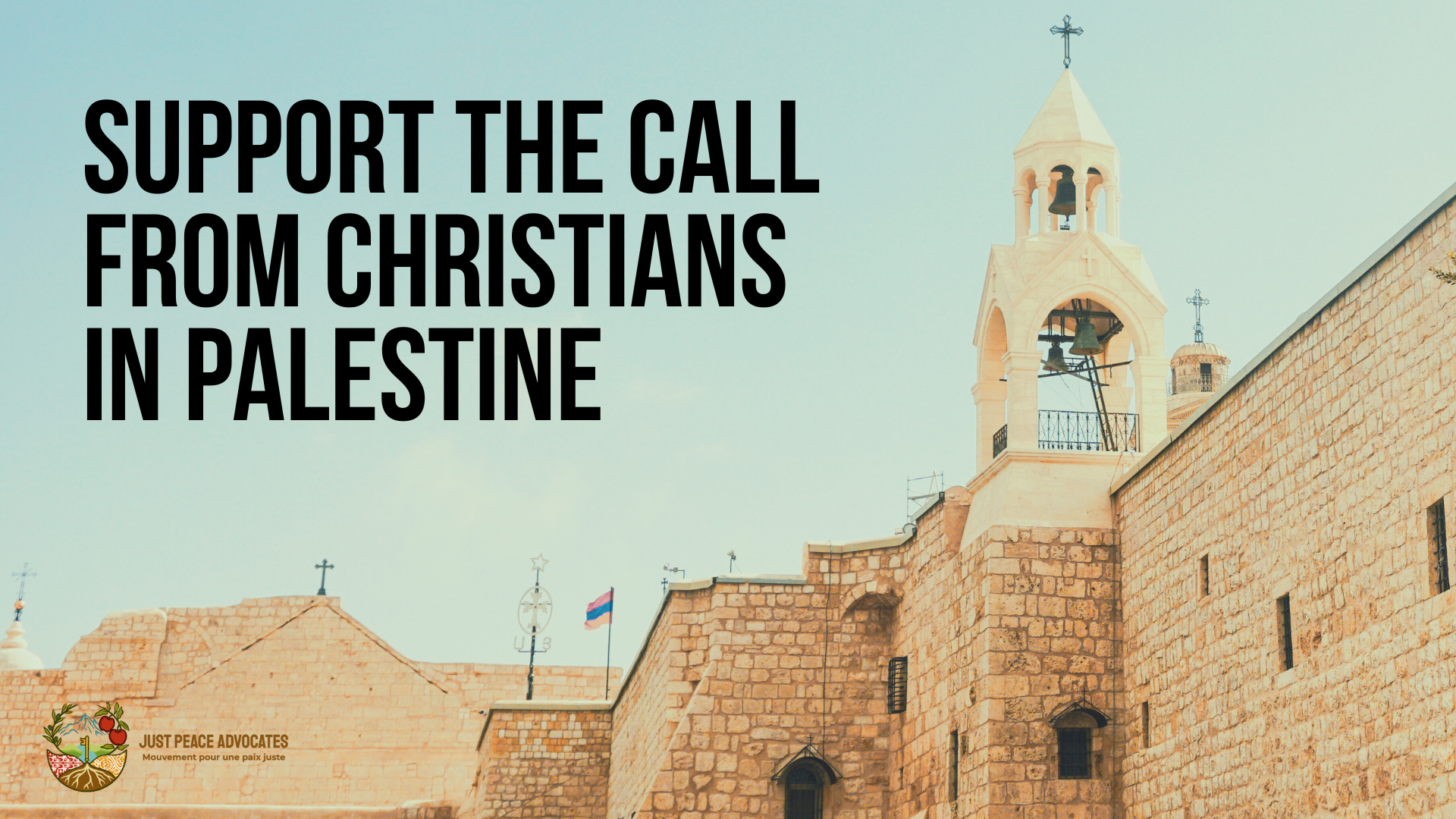
Palestinians called out to the world in the 2009 Kairos Palestine “Moment of Truth: a word of faith, hope and love from the heart of Palestinian suffering.” With this Kairos Palestine set in motion a global movement, rousing the churches to action and awakening civil society to the reality of Palestinian suffering. However, the response was and continues to be wholly insufficient.
In June 2017 on the 50th year of the occupation an open letter from Christians in Palestine to the National Coalition of Christian Organizations in Palestine (NCCOP) was sent to the World Council of Churches and the ecumenical movement saying “[w]e are on the verge of a catastrophic collapse.This could be our last chance to achieve a just peace.”
The call of the Palestinian Christians urged churches to:
- recognize Israel as an apartheid state;
- condemn the Balfour declaration as unjust;
- take a clear theological stand against any theology or Christian group that justifies the occupation and privileges one nation over the other based on ethnicity or a covenant;
- revisit and challenge religious dialogue partners;
- defend the right of Palestinian Christians to resist the occupation creatively and non-violently support BDS.
- publicly and legally challenge Christian organizations that discredit our work and legitimacy
Still Canadian churches remained silent.
Then in 2020, Kairos Palestine made a call “Cry for Hope” to the international Christian community. This included affirming the Palestinians’ right to resist. Close to 25,000 people worldwide signed a petition, and worldwide Christian churches and organizations were asked to endorse. In Canada, the churches have been silent with only “qualified” endorsements from the United Network for Justice and Peace in Palestine and Israel (UNJPPI), a KAIROS Canada staff with some unnamed church leaders from the United Church of Canada, Anglican Church of Canada and the Evangelical Lutheran Church in Canada, saying they could not support the full statement.
In 2023, Palestinian Christians called for modest Christmas celebrations, and issued a Call for Repentance. Even in the midst of genocide, the response from the Canadian Council of Churches and its members was silence.
The Canadian Council of Churches while somewhat active in regard to Palestinian human rights and international law at one time, has been at best quiet over the last few decades despite a more proactive approach by the World Council of Churches.
Kairos II, A Moment of Truth: Faith in a Time of Genocidewas released at the 16th Kairos Conference in Bethlehem in November 2025. Kairos II names the genocide in Gaza, the “silent genocide” in the West Bank, and the ethnic cleansing and apartheid across historic Palestine.
It specifies:
Genocide is a cumulative process — one that began in the minds of the settler-colonial powers of Europe when they denied the image of God in others and legitimized death, domination and slavery. We consider the State of Israel, established in 1948, to be a continuation of that same colonial enterprise built on racism and the ideology of ethnic or religious superiority. This project settled Palestine and worked to displace the indigenous people of Palestine from the time of the Nakba until today. Our present Palestinian reality is the inevitable outcome of Zionist ideology and the supremacist settler-colonial movement, itself a product of the imperial mindset.
It asks:
How can one speak of Christian fellowship or communion while denying, supporting, justifying or remaining silent before genocide.
It says:
We have heard much talk of political solutions and peace while the reality on the ground says otherwise. To speak of a political solution today is futile unless we first undertake the serious work of acknowledging and rectifying past wrongs—beginning with recognition of the historic injustice done to Palestinians since the rise of the Zionist movement and the Balfour Declaration.
Kairos II asks for international Christians to act. This includes
- Taking action to dismantle settler colonialism and the apartheid system built on Jewish supremacy as codified in Israel’s racist Nation-State Law.
- Rejecting proposals for a weakened, conditional state lacking full sovereignty over its borders, waters, airspace and security.
- International action and protection, accountability for war criminals, and compensation for survivors of genocide, the Nakba, and settler colonialism. Enduring solutions will not rest on the logic of force, but on the foundations of justice, equality and the right to self-determination.
- Supporting global movements of resistance, advocacy and popular pressure that work to hold governments and international bodies accountable — isolating Israel through boycotts and sanctions until it complies with international law.
- Ensuring independence of decision-making and the right to self-determination. This includes a warning against giving the Palestine national struggle a religious character or turning it into a religious issue that pits religions against one another.
- Creative resistance embodied in the popular Palestinian movements confronting occupation, settlement expansion, settler terrorism and apartheid as well as in the work of civil society organizations, legal and human rights initiatives, cultural, theological and diplomatic engagement, and in student and labor movements
- A global theological movement that arises from the contexts and struggles of peoples suffering from colonialism, racism, apartheid and the structural poverty produced by corrupt economic and political systems that serve the interests of the world’s empires.
- Rejecting the oppression and injustice produced by the theology of racism, colonialism and ethnic supremacy embodied in Christian Zionism, a theology that has produced apartheid, ethnic cleansing and genocide of indigenous people.
- Rejecting every attempt to conflate antisemitism with opposition to apartheid and with pressure to hold Israel accountable under international law —
- Calling on governments of the world: to press for the prosecution of war criminals whoever they may be under the jurisdiction of the International Court of Justice and the International Criminal Court; to ensure reparations for the Palestinian people, both in their homeland and in the diaspora; and to work for the immediate return of the displaced through the reconstruction of Gaza and the strengthening of its people’s steadfastness.
This is “a Call on the churches of the world to distinguish between dialogue with Jews and dialogue with Zionism — indeed, to boycott dialogue with Zionist voices that have supported and continue to support occupation, apartheid and the genocide of the Palestinian people. Instead, we call upon the churches to stand with and amplify prophetic Jewish voices that call for justice and truth.”
It is certainly well past time for the Canadian Council of Churches and its member denominations and affiliates to speak out, and support the call from Christian churches in Palestine. During over two years of genocide, the Canadian Council of Churches made one pathetic statement that did not name Israel’s occupation, apartheid, nor genocide, writing as if Gaza was a natural disaster of some sort, stating solidarity with Israelis and asking the Israeli government to allow aid.
As a Christian Palestinian denied since 1948 the inalienable right to return to my homeland, I view the silence of the Canadian Council of Churches—while a regime found by leading UN bodies and human rights organizations to be inflicting apartheid, occupation, and genocide on indigenous Palestinians—as a profound moral and legal failure, betraying both Christian ethics and Canada’s stated values.
Khaled Mouammar, A Christian Palestinian Arab Semite from Nazareth denied the right to return since 1948 because of my religious and ethno-cultural category. former national president of the Canadian Arab Federation and a former member of the Immigration and Refugee Board of Canada.
Ask the Canadian Council of Churches and its members and affiliates how they can speak of Christian fellowship or communion while denying, supporting, justifying, or remaining silent in the face of genocide.